
Silver halide Denisyuk hologram
School of Creative Industries and Culture (CIC)
Creative Practice Biennial 10 July – 22 August 2026
Leicester Gallery, De Montfort University
Background
As an artist and technologist working in a university setting, I wanted to explore whether consumer AI could support me with 3D modelling. I wanted to develop my own skills and understanding in a playful and open manner. Serendipitously, Katharine Short from the DMU Special Collections gave a presentation in which I first came across the 1958–59 prospectus cover shown below. I thought it would be interesting to reflect on the historical and contemporary intersection of Art and technology by experimenting with the design in 3D.
This text is written in the first person and avoids academic jargon, as I want to invite you, and all potential readers, into this journey of discovery.
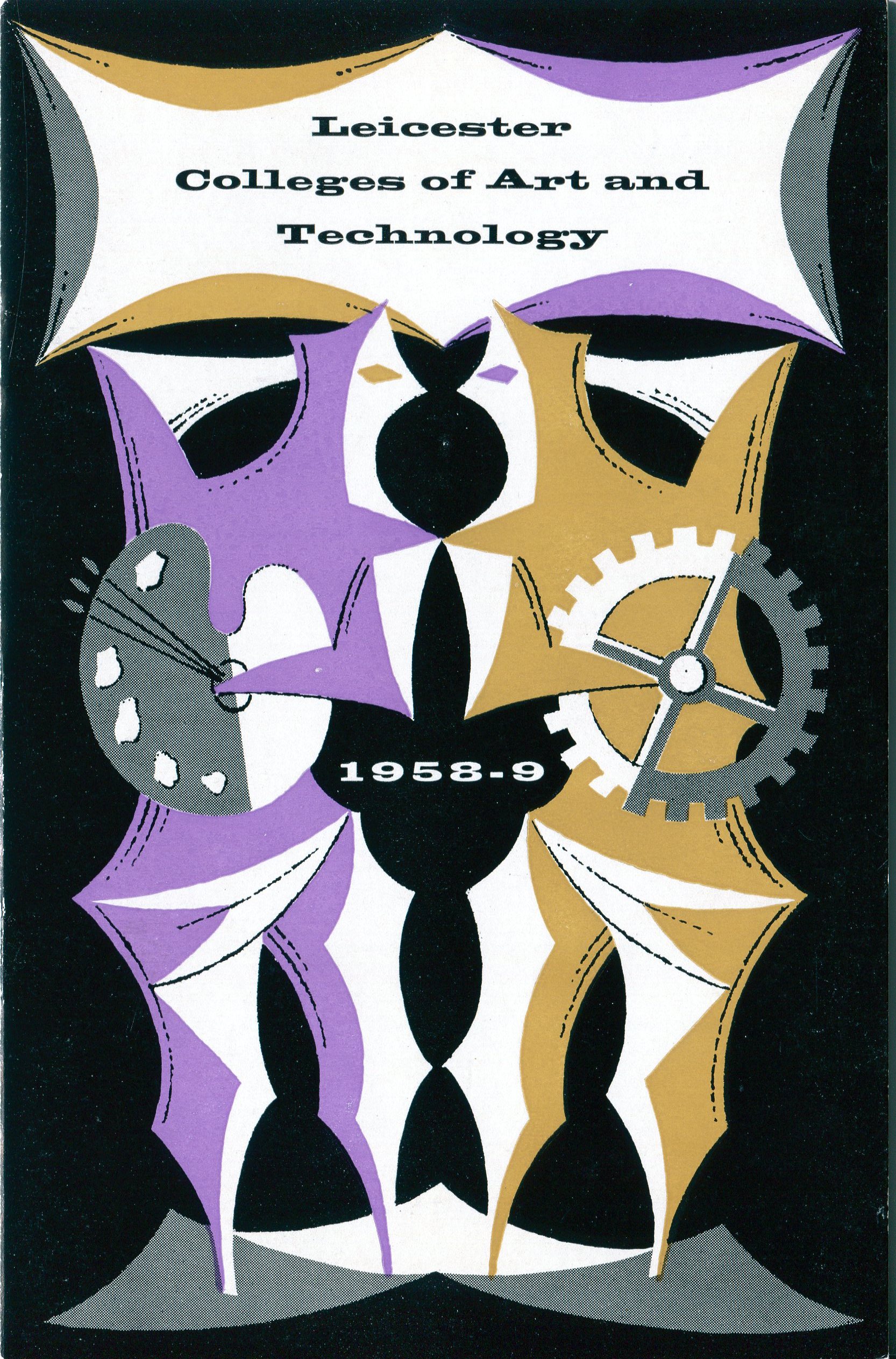
The ‘Art and Tech’
Leicester School of Art was founded in 1870 and underwent several name changes over the next 122 years before it became De Montfort University in 1992. One of these was in 1929, when it became the Leicester College of Arts and Crafts and the Leicester College of Technology. The Arts College taught architecture, building crafts, furniture making, printing, book production, metalworking, dress design, weaving, drawing and painting. Meanwhile, the College of Technology offered education in boot and shoe manufacture, hosiery and textiles, chemistry, dyeing, pharmacy, physics, mathematics, engineering, office management, and scientific information for trades such as grocery, butchery, bakery and confectionery.Known locally as the ‘Art and Tech’, the Colleges provided vital vocational and practical education to the people of Leicester until 1969, when they became Leicester Polytechnic. Their organisational structure featured a separate headmaster for each College but shared facilities, resources and administration. Students were encouraged to take relevant courses from the other College; for example, a footwear design student at the Art College might take a module on shoe construction at the Technology College. Marketing materials from the Art and Tech era play on the dual nature of the Colleges, with student magazine names like Duo and Gemini, and matching prospectus designs. The 1958-59 prospectus is the most striking of these: the complementary figures of art and science are shown in mirrored poses, Art holding a palette and brushes, Technology holding a mechanical gear. Unfortunately the names of the artist and/or graphic designer are not recorded, but they were likely to have been staff of the College which had a School of Printing and Graphic Design.
The original prospectus can be viewed at DMU Special Collections which holds the institutional archive (reference DM/A/076). See https://library.dmu.ac.uk/specialcollections for more information.
KathArine SHORT – DMU Special Collections (2026)
AI reflection
During the whole process, I felt quite conflicted about my use of AI. I am naturally curious and enjoy encountering new technologies. However, I am also aware that using AI has a significant impact on global resources. I found myself wishing that I had a little meter showing how much energy and water my process demanded each day. I simply don’t know. I do not know whether it is justifiable or ethical. We need to find out together.
In my role as a Senior Lecturer at a UK university, I have to build a practical understanding of AI so that I can guide my students to the best of my ability. The students also teach me a lot: some use AI confidently and appropriately, while others disapprove of all use of it.
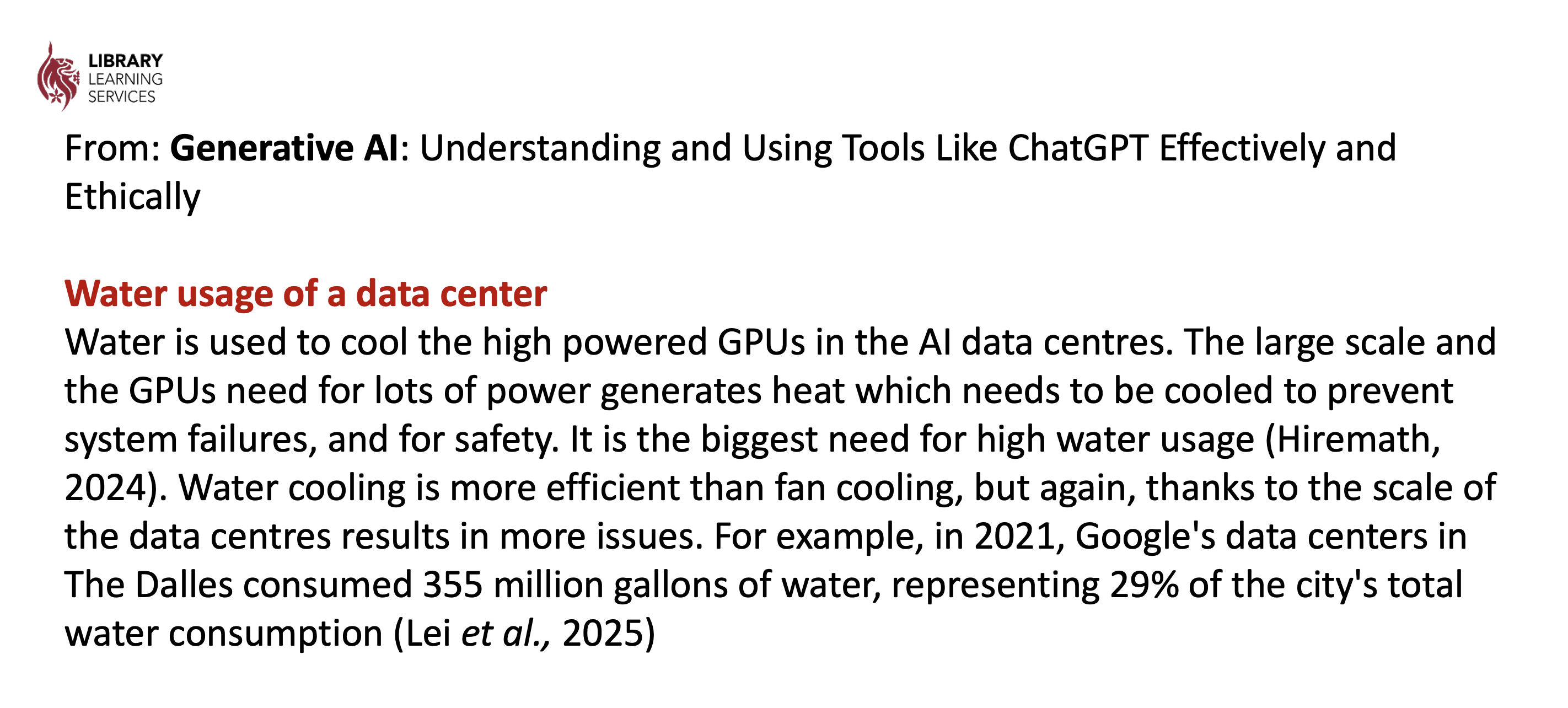
There are also current debates about creative authorship and AI. The Special Collections team and Katharine Short had not been able to identify who designed this 1958 cover, despite genuine efforts to do so. I would, of course, have cited the original artist if that had been possible. We decided that, for the purposes of this small project, it was ethically acceptable to train the AI using the prospectus cover image.
Workflow
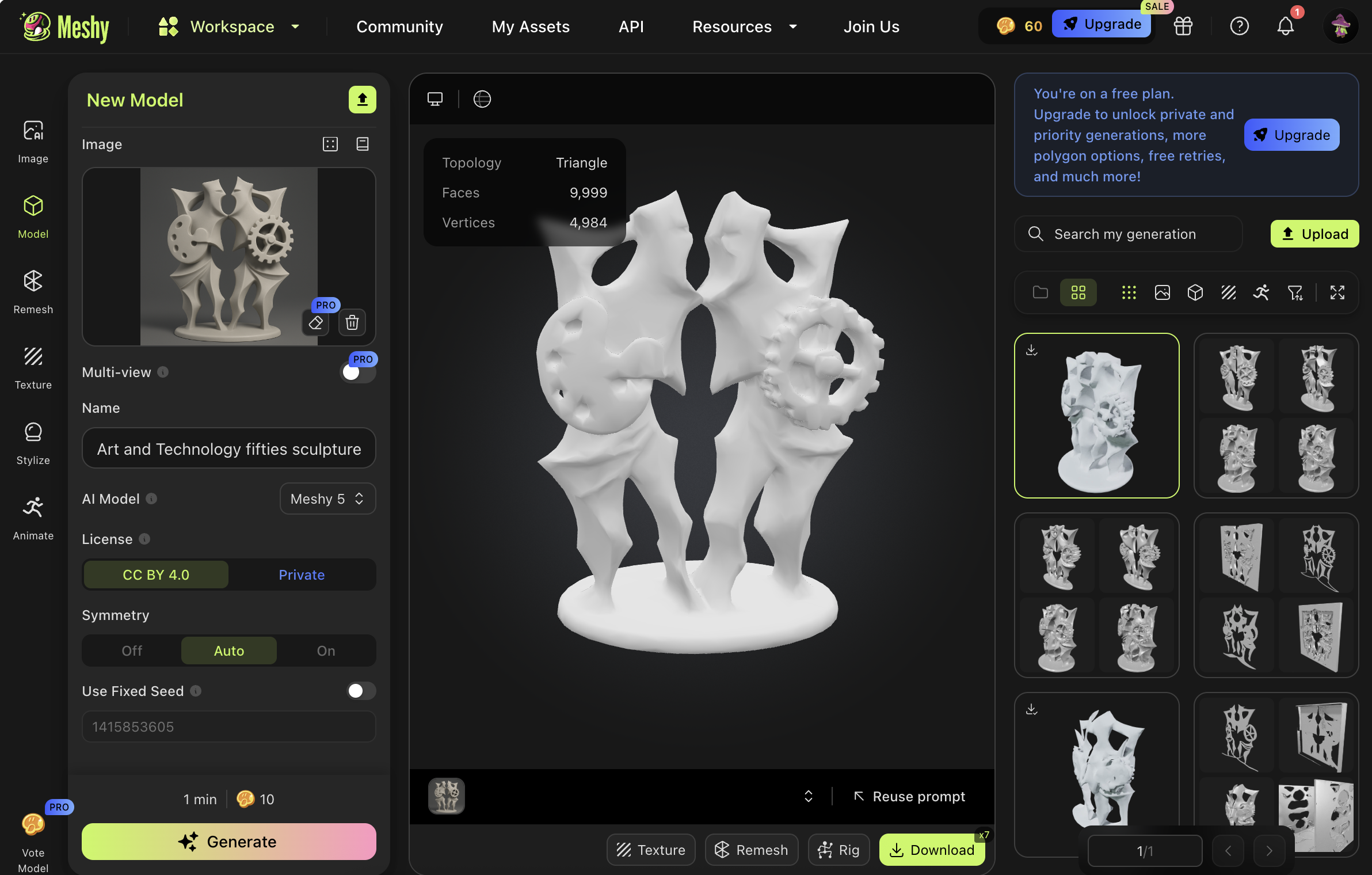
It turned out that it was not so easy to create a 3D-printable .stl model using the online automated tools that were available.
Below are some screenshots of various attempts.
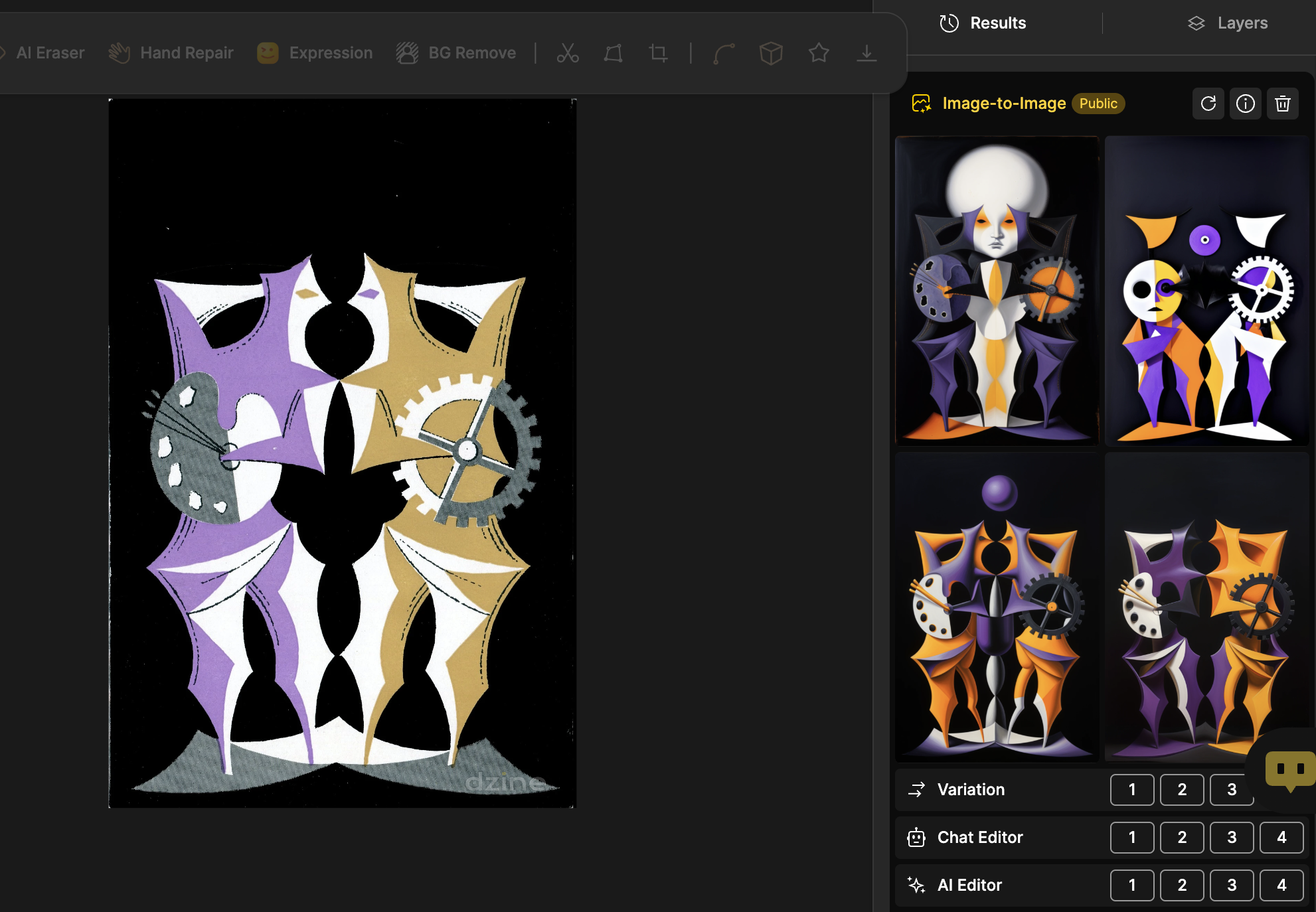
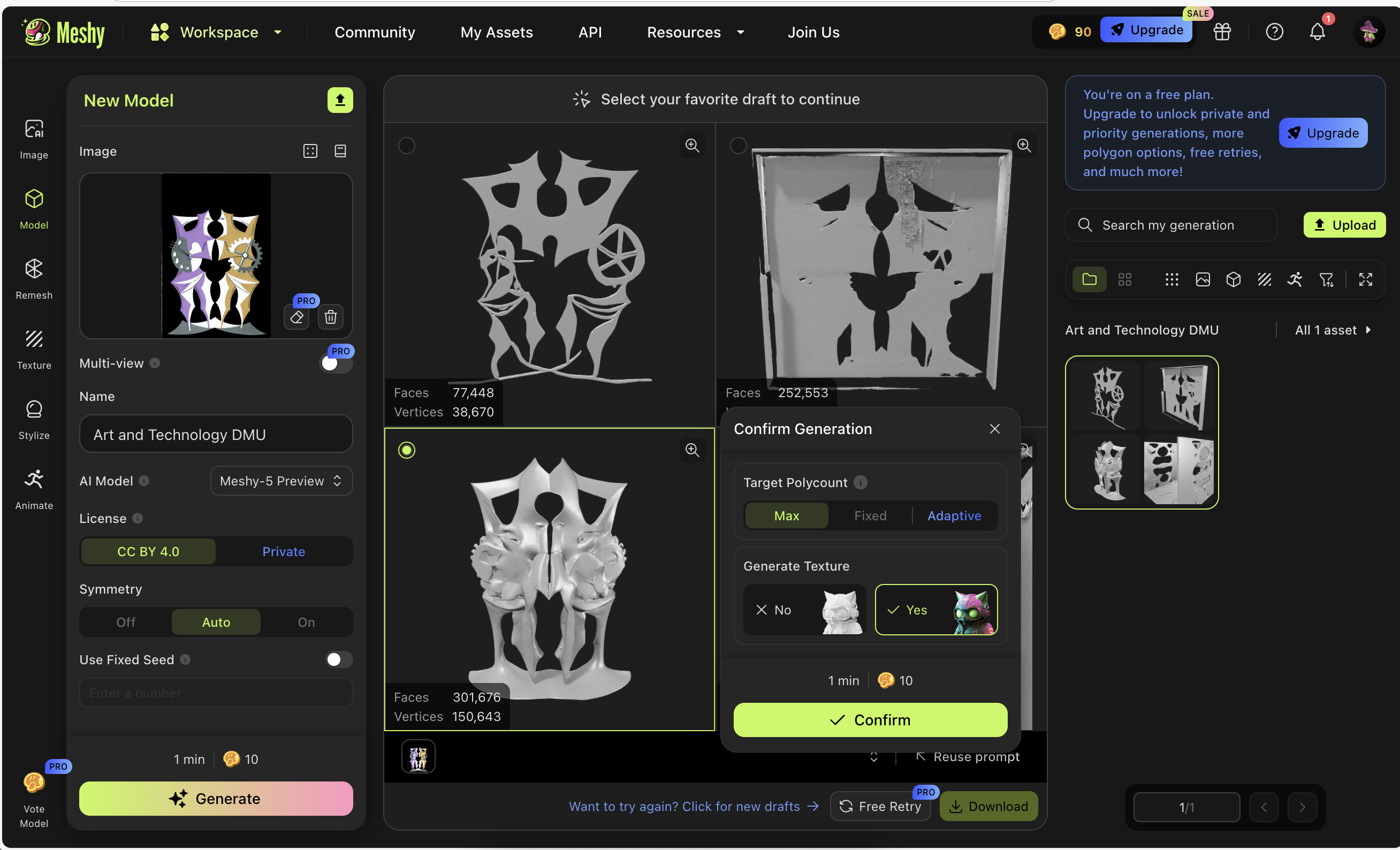
Whilst the Large Language Model (LLM) ChatGPT struggled to produce printable 3D .stl models, it generated interesting mock-ups of 3D sculptures as 2D images.
Below are some of the ideas generated by Chat GPT.
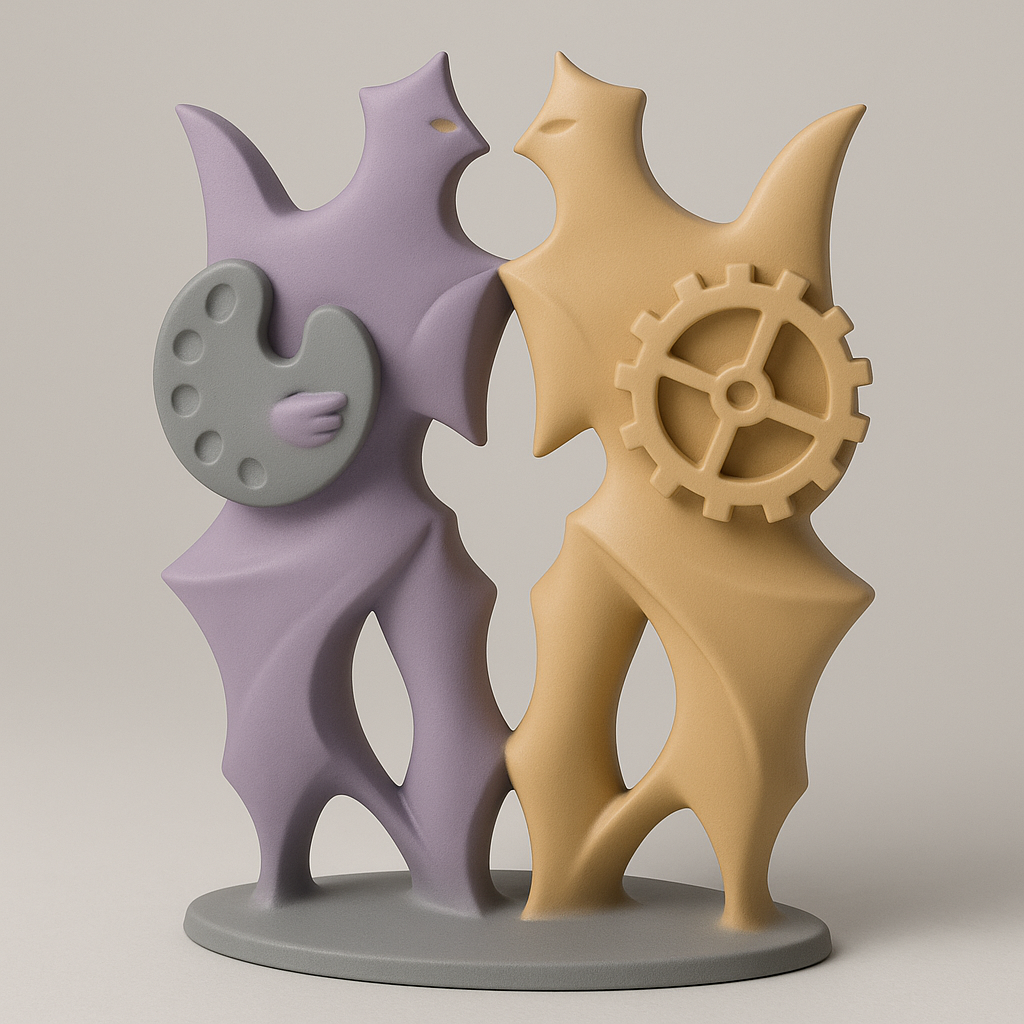
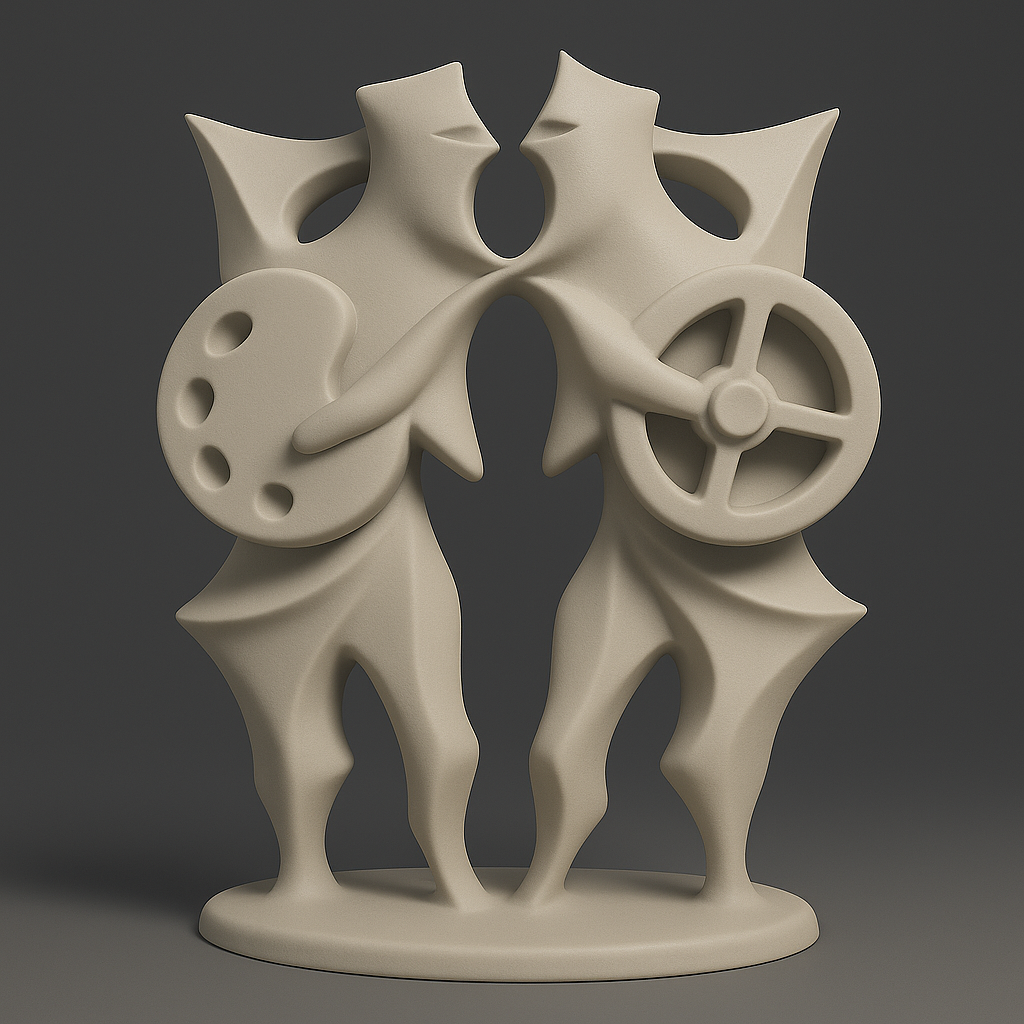
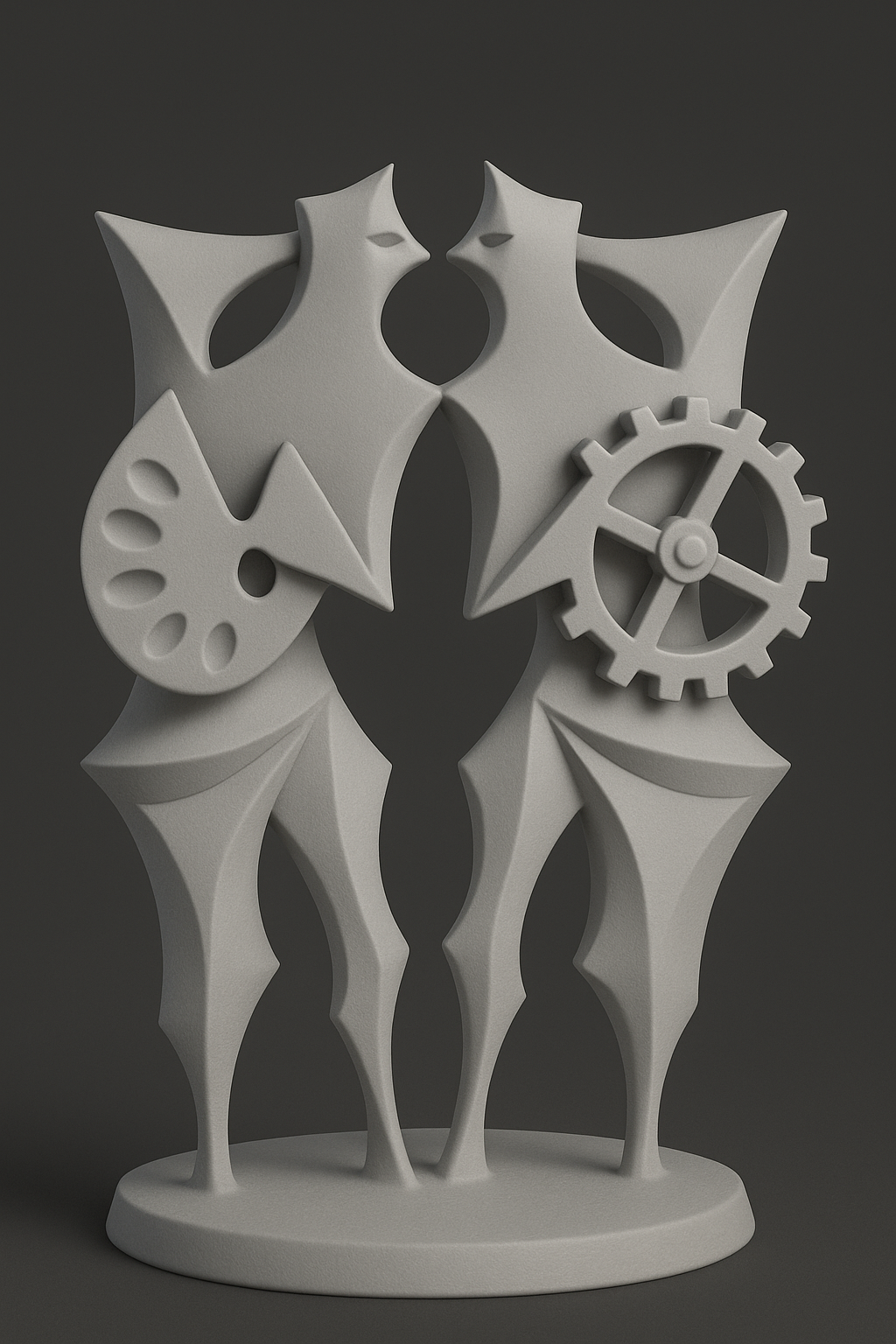

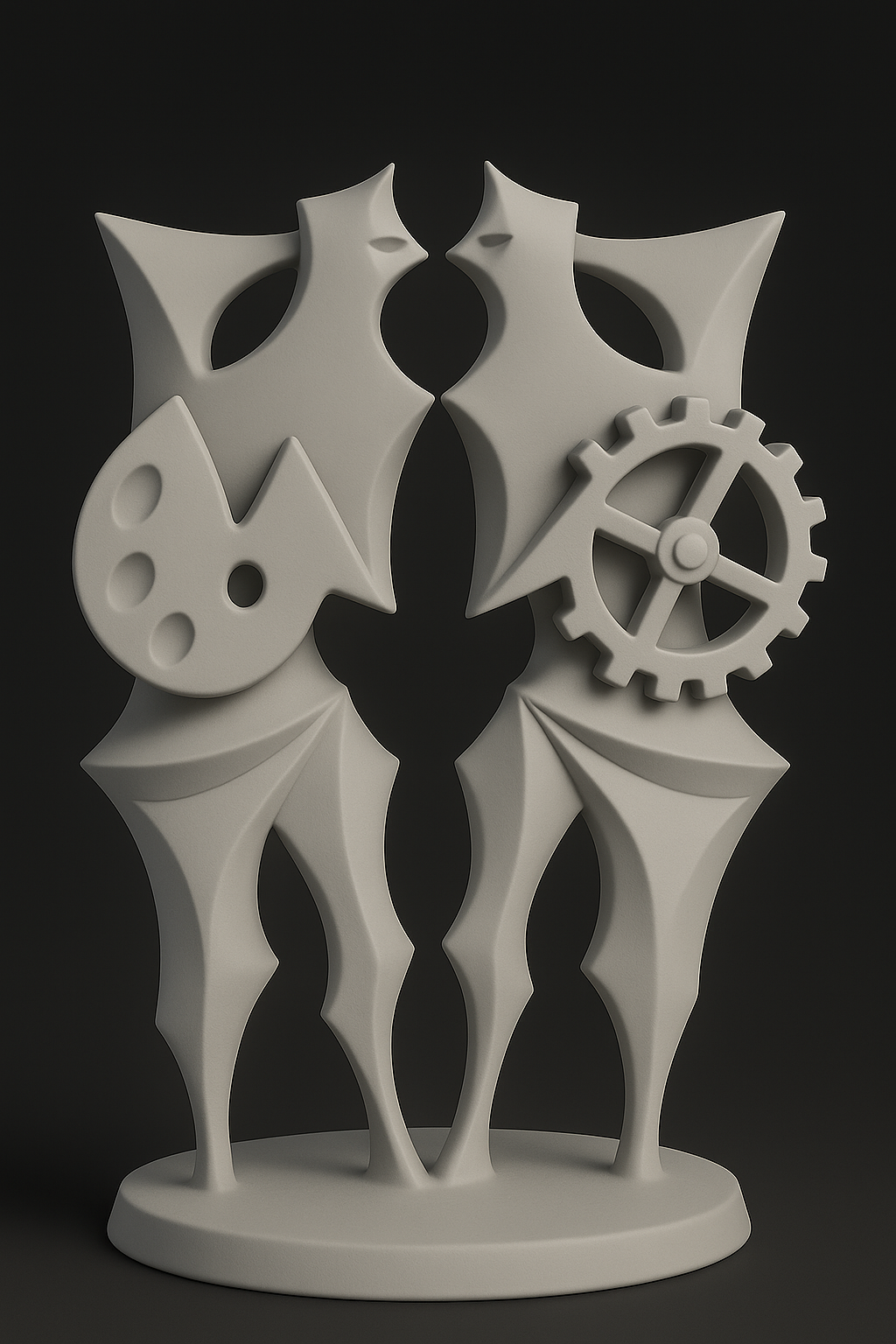
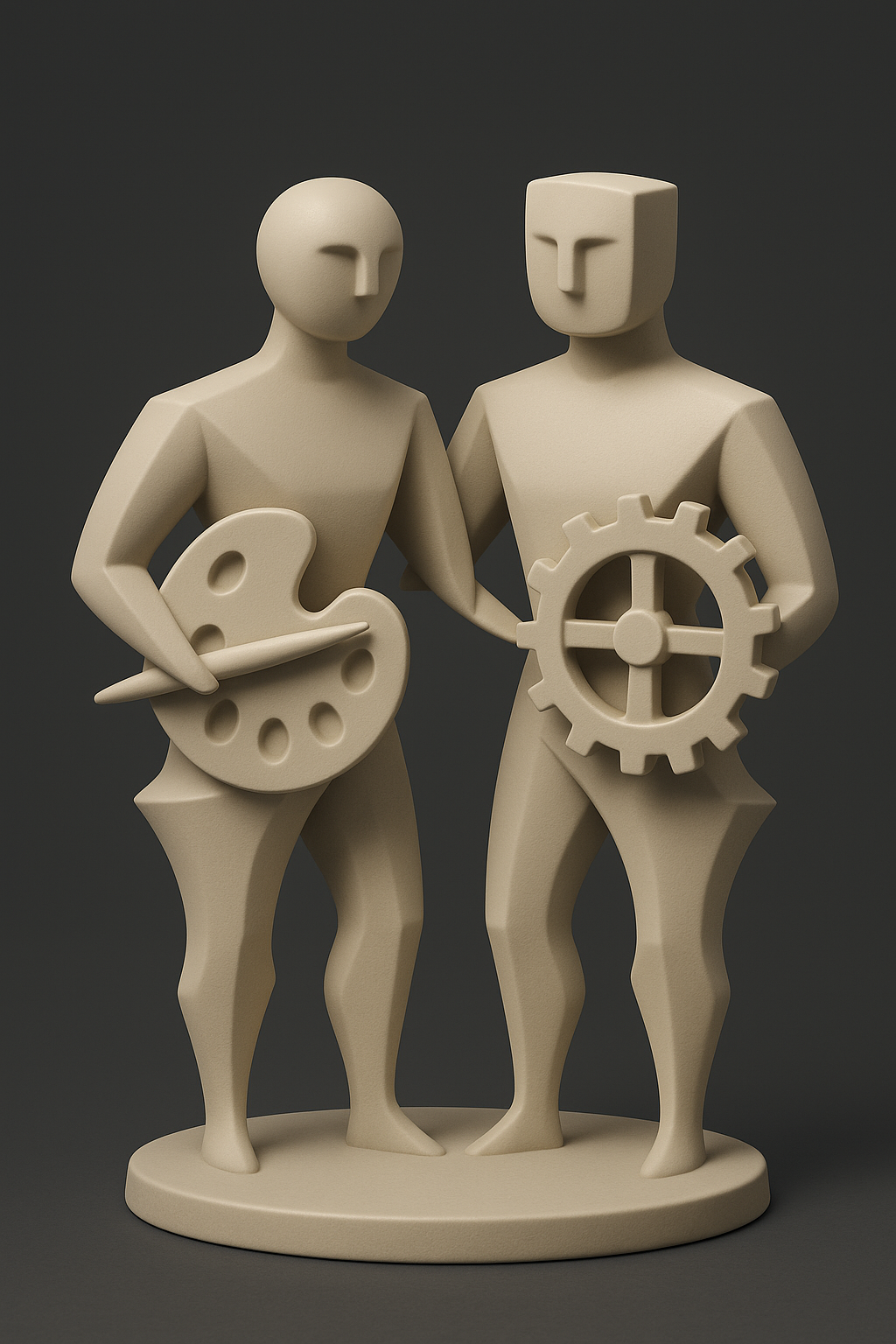
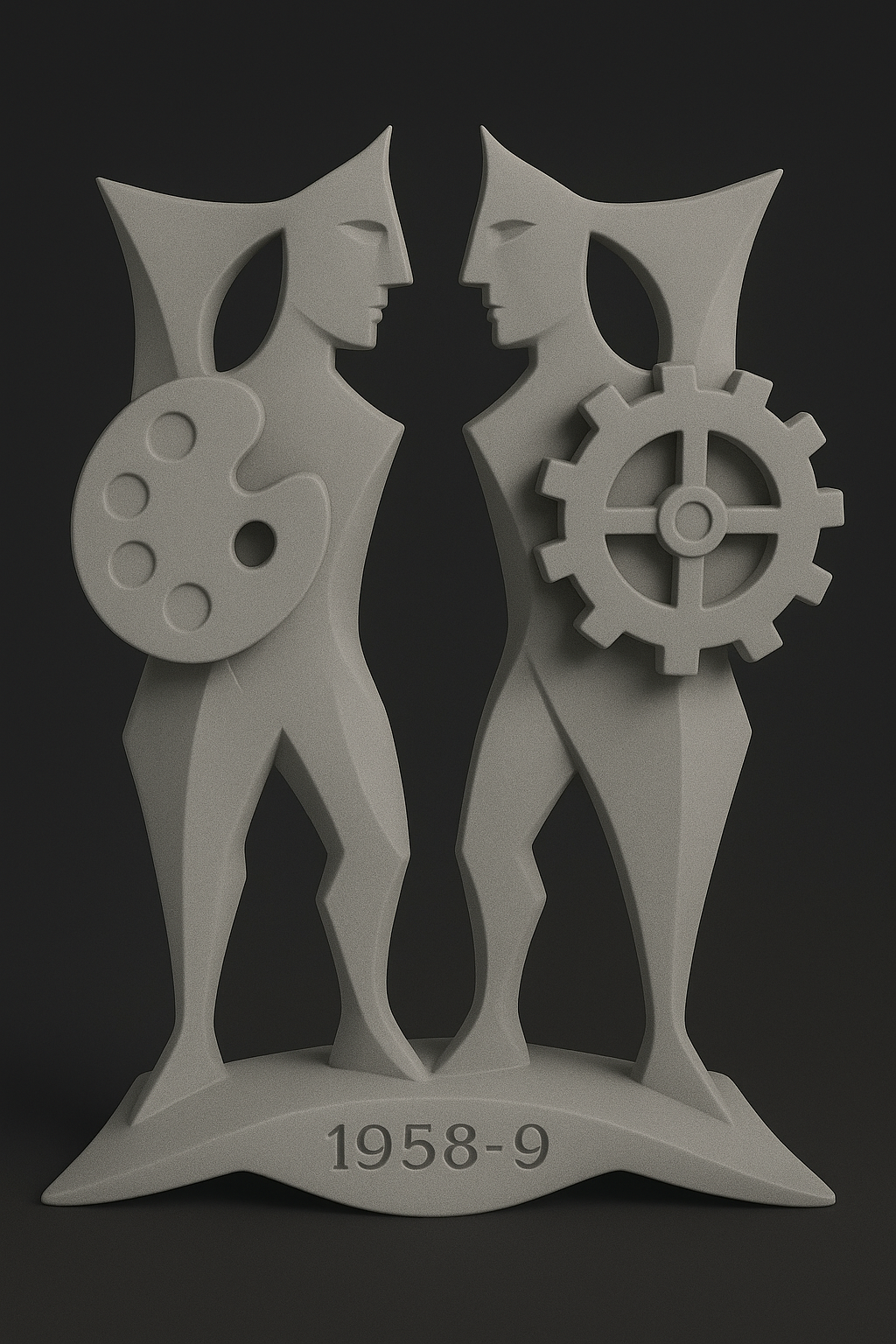


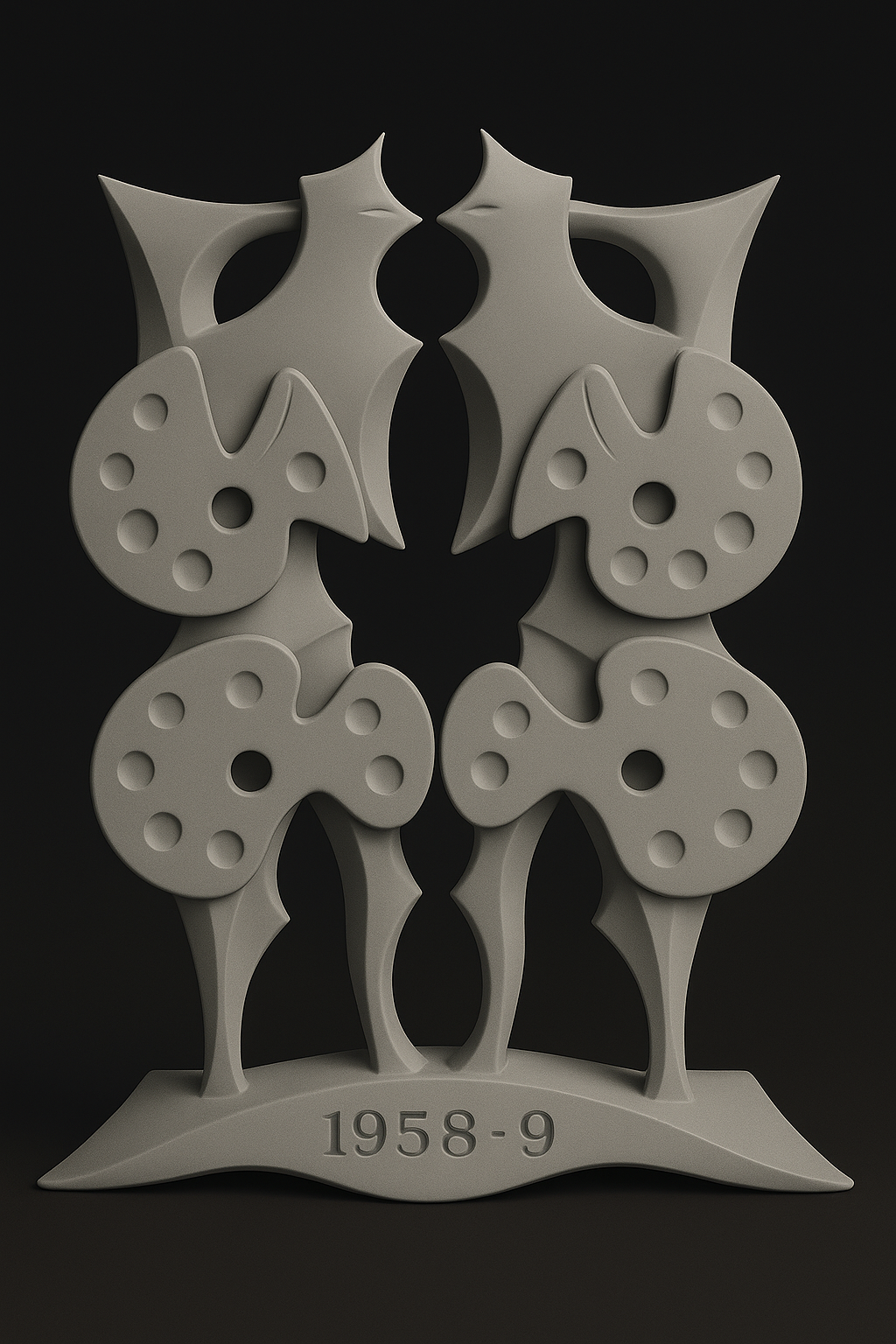


In the set of images above, I noticed that ChatGPT represented Art as a female figure and Technology as a male figure. The original prospectus cover is not gendered in this way. I reflected that this may reveal an inherent bias within the AI system, as it reproduces wider cultural assumptions embedded in its training data.
ChatGPT confidently claimed that it could create an .stl model for 3D printing, first by generating .stl files such as the one shown below.
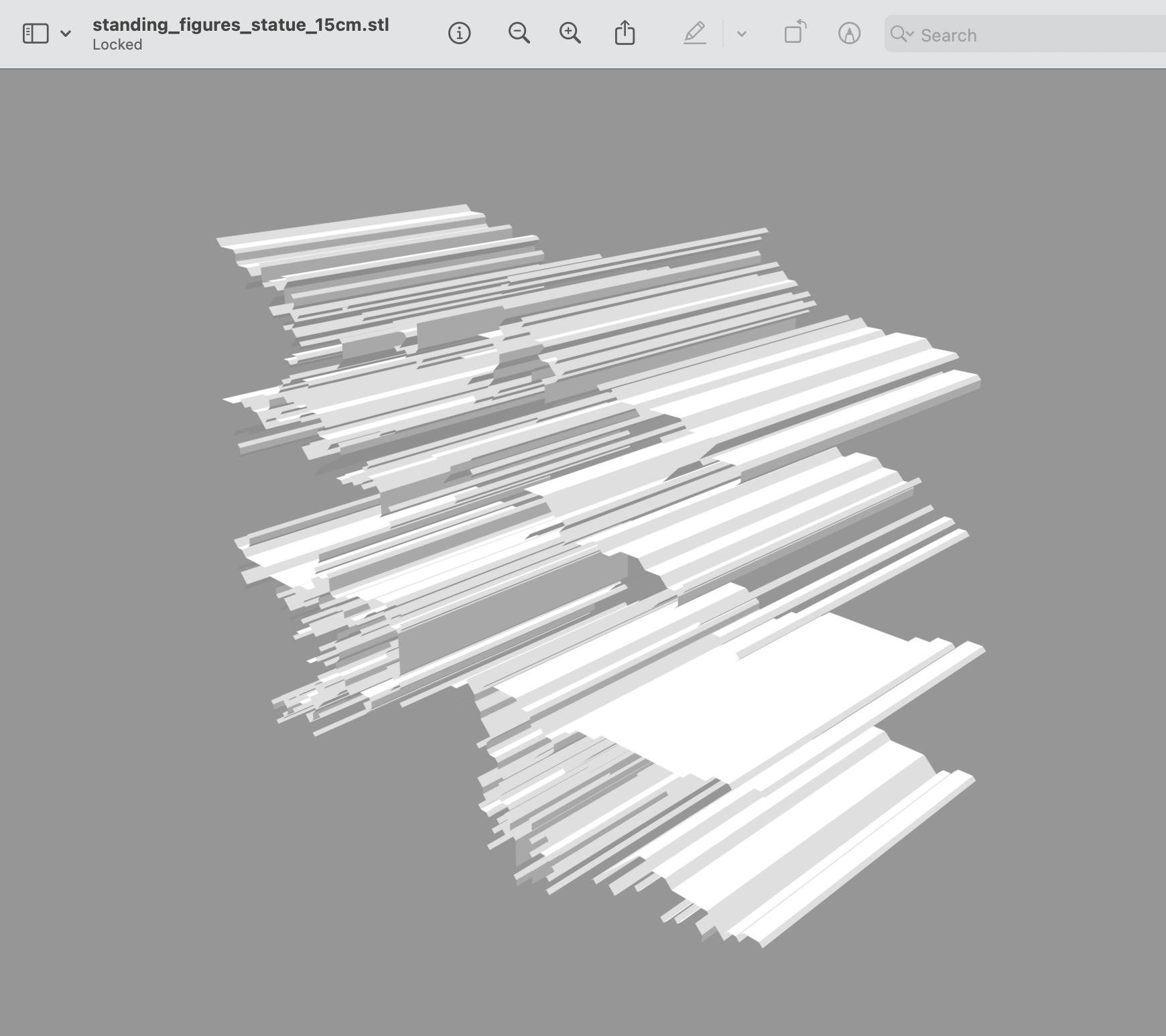
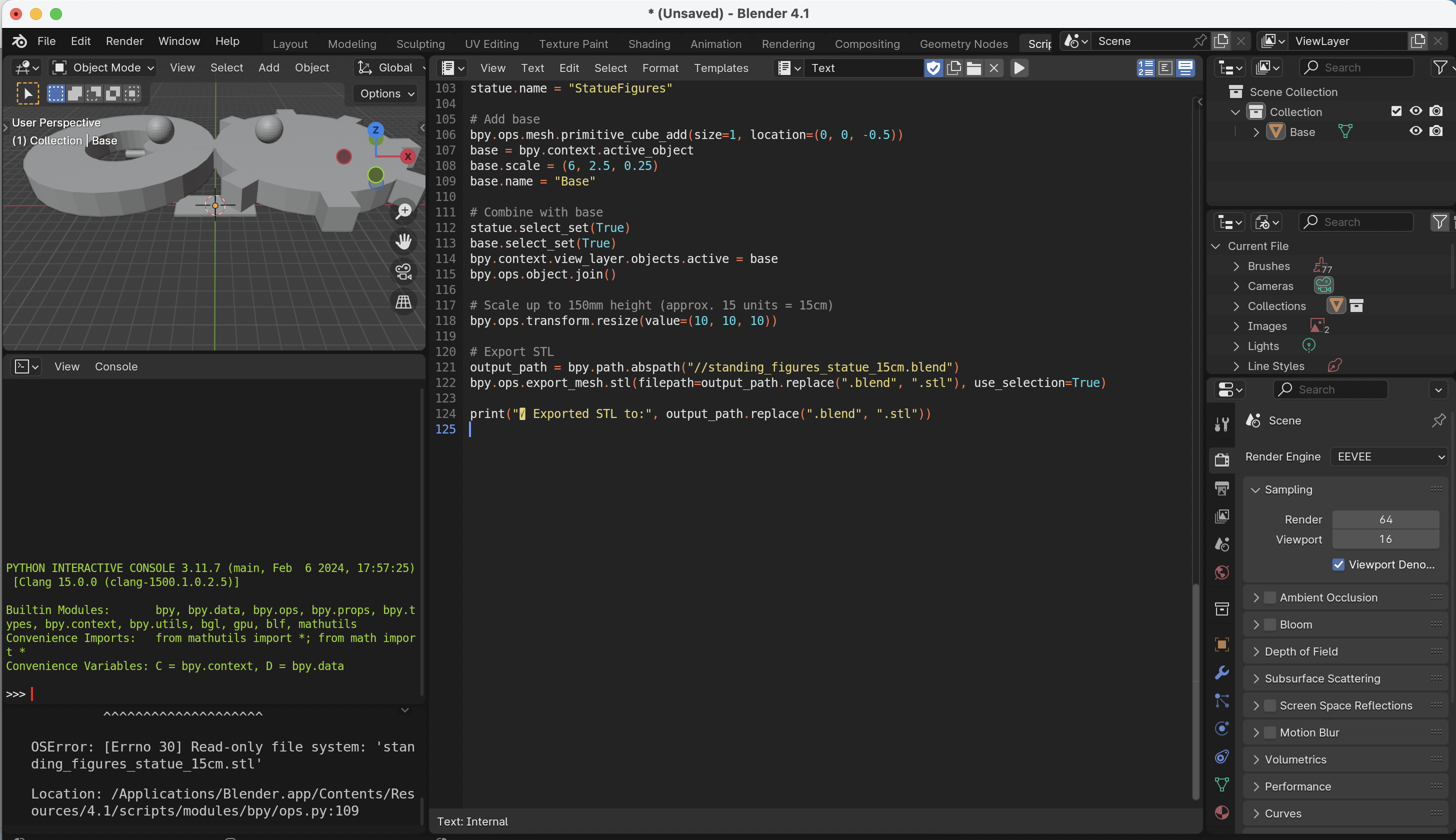
Thereafter ChatGPT claimed that it could generate code to build the model in the 3D modelling program Blender. However, when I opened the code in Blender, the results were not convincing and did not provide a useful starting point for further development.
ChatGPT then suggested that I could contact a human 3D freelance artist.
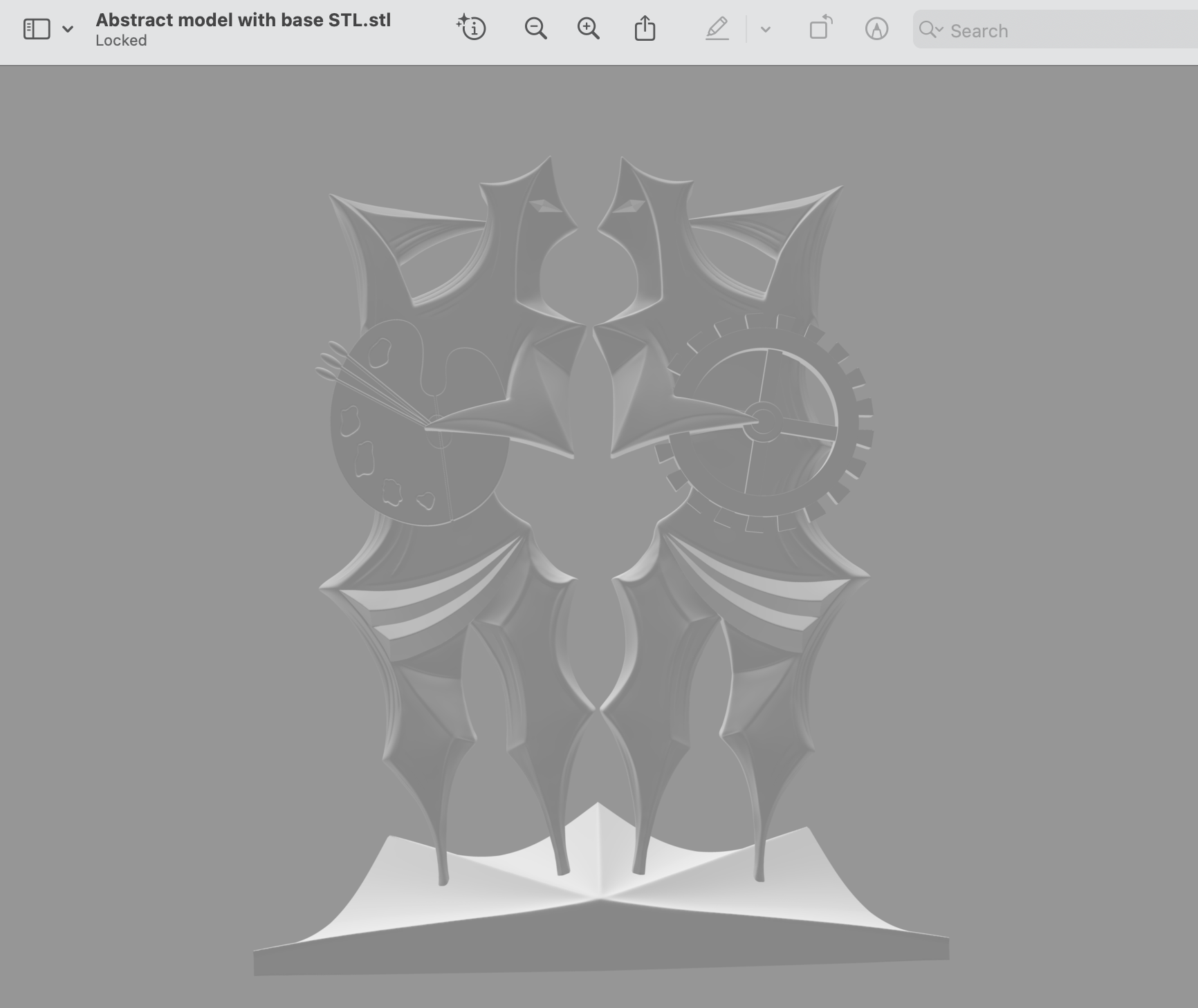
I commissioned a 3D .stl model from Rauf Valiyev through Fiverr. Rauf kindly gave permission for me to cite his work.
DMU Technical Instructor Ray Yau supported the 3D printing process.
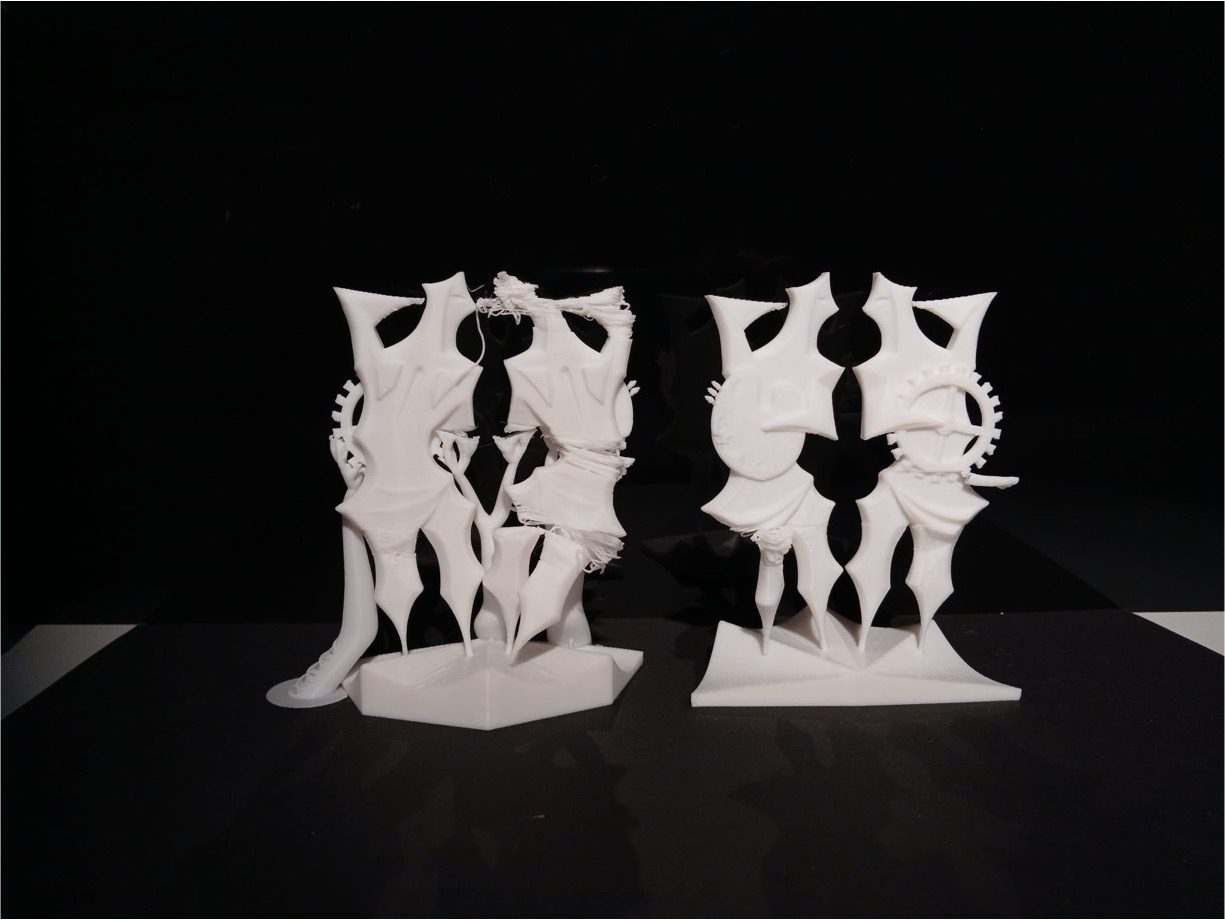
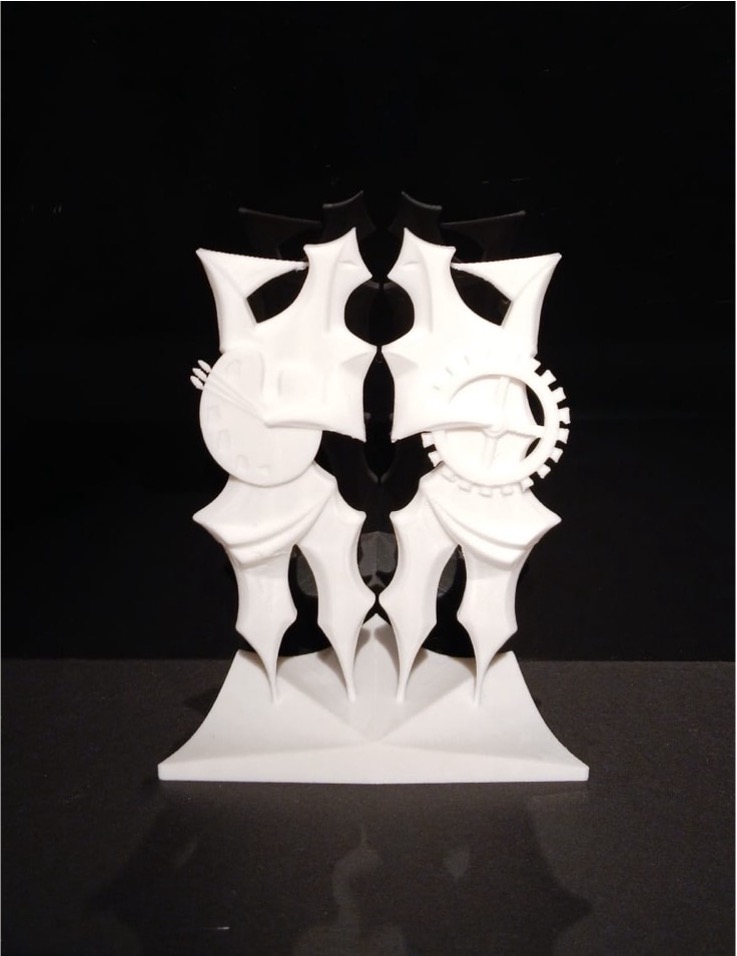
See the documentation of the 3D printing process below. Photographs T. Dalenius 2025.
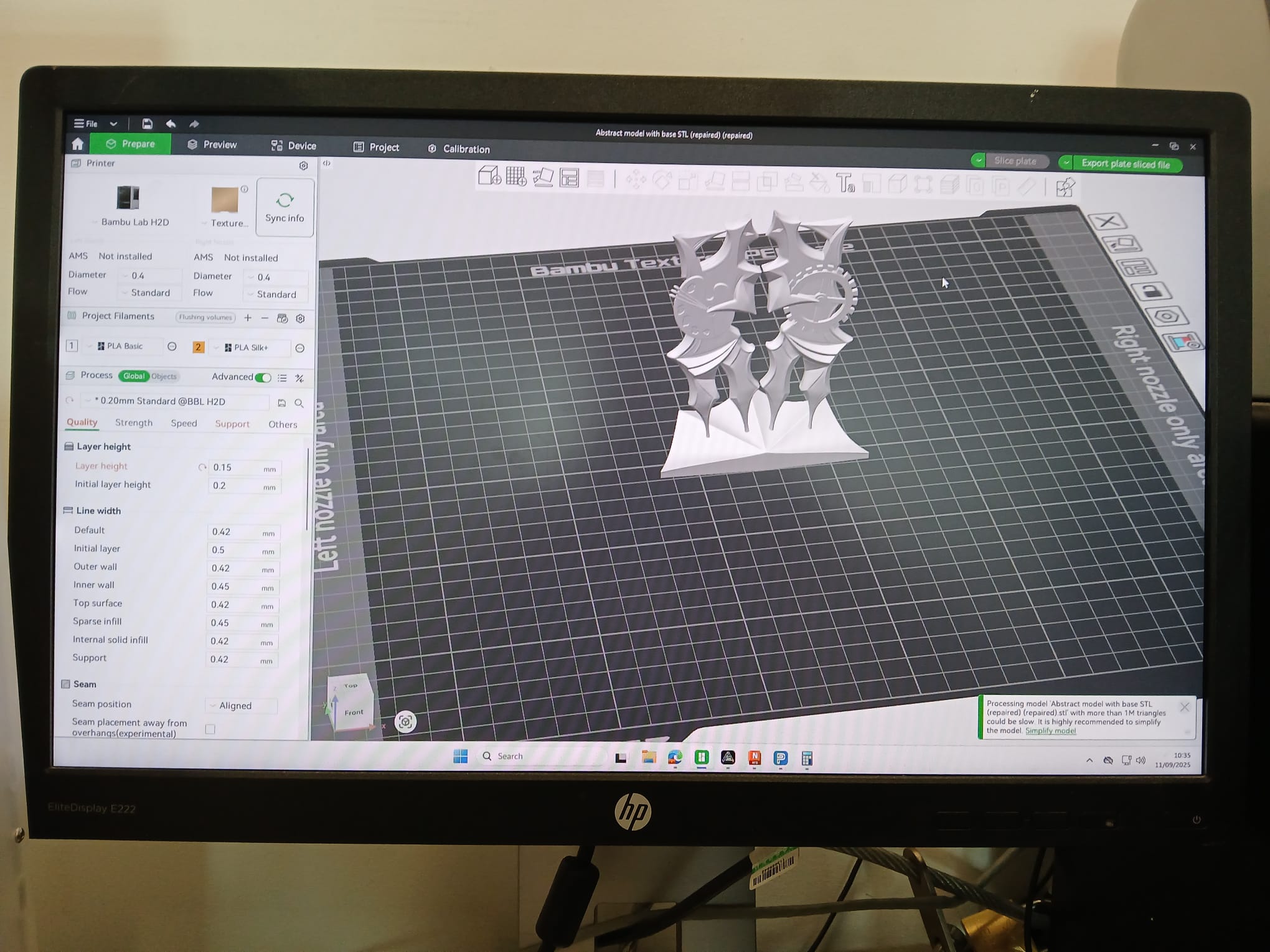
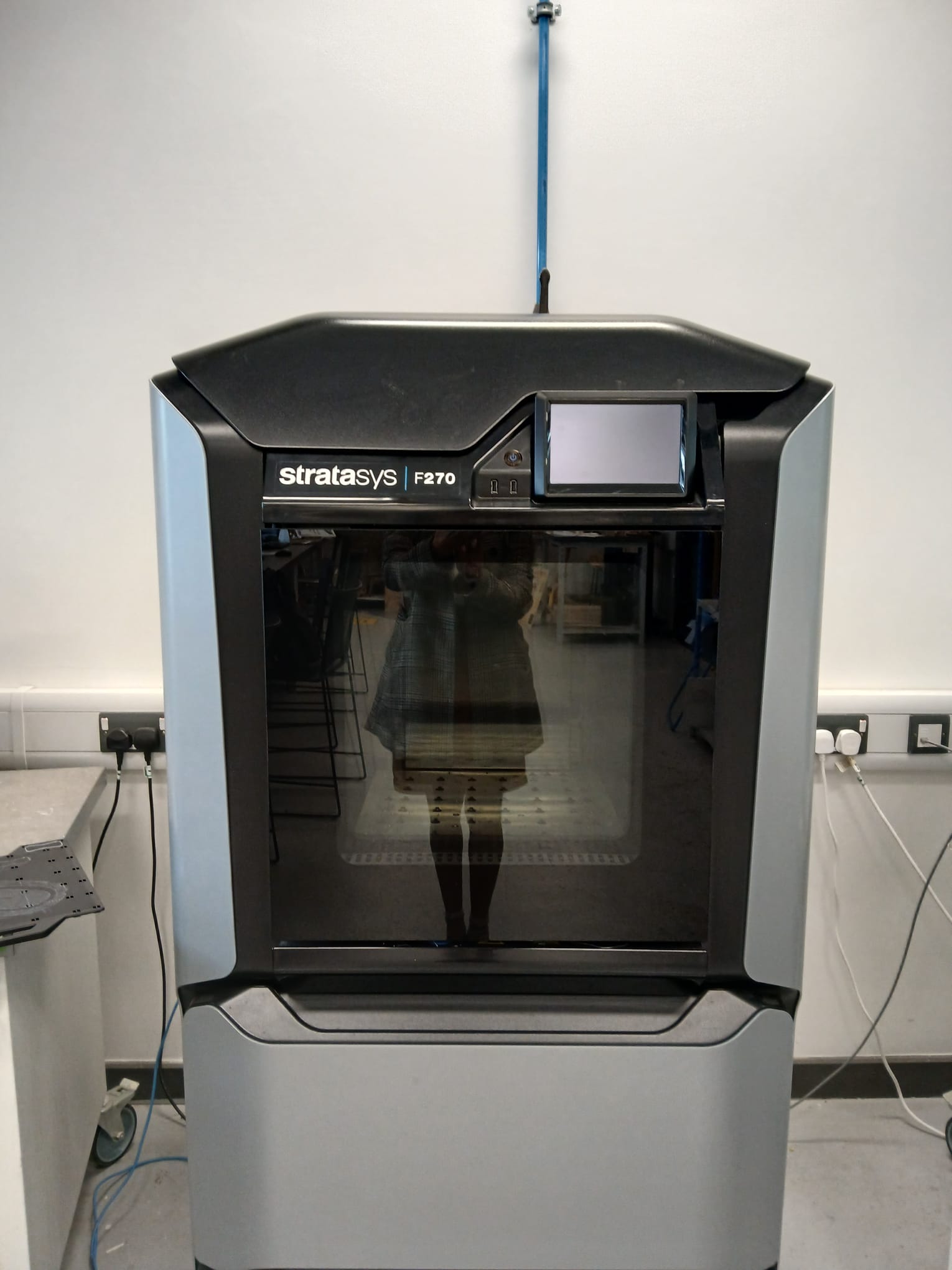
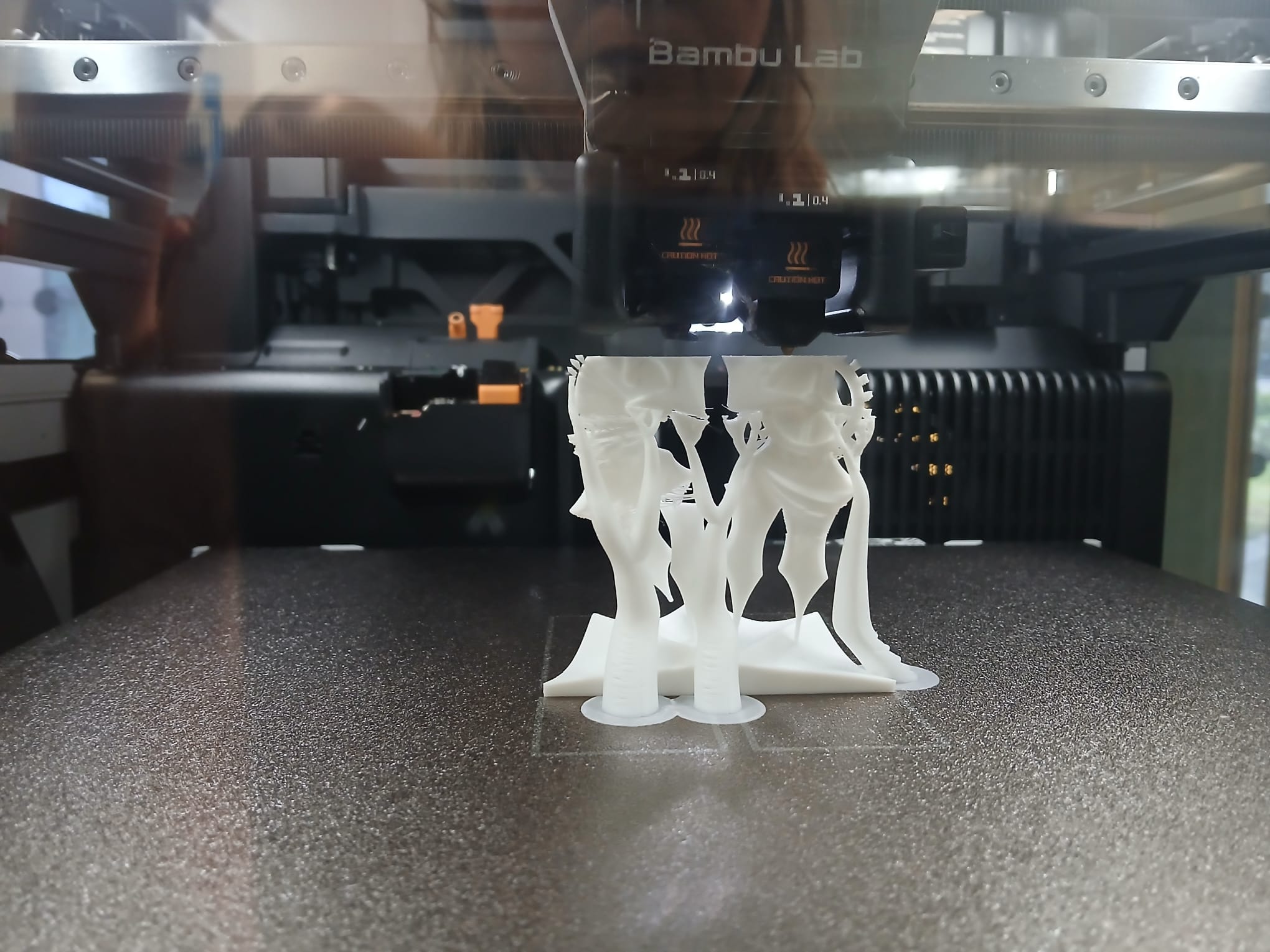
The initial version was too small, and the prints failed. Some of my colleagues in Fine Art suggested that the failed prints were more interesting than the successful ones. This may be a departure point for future exploration.
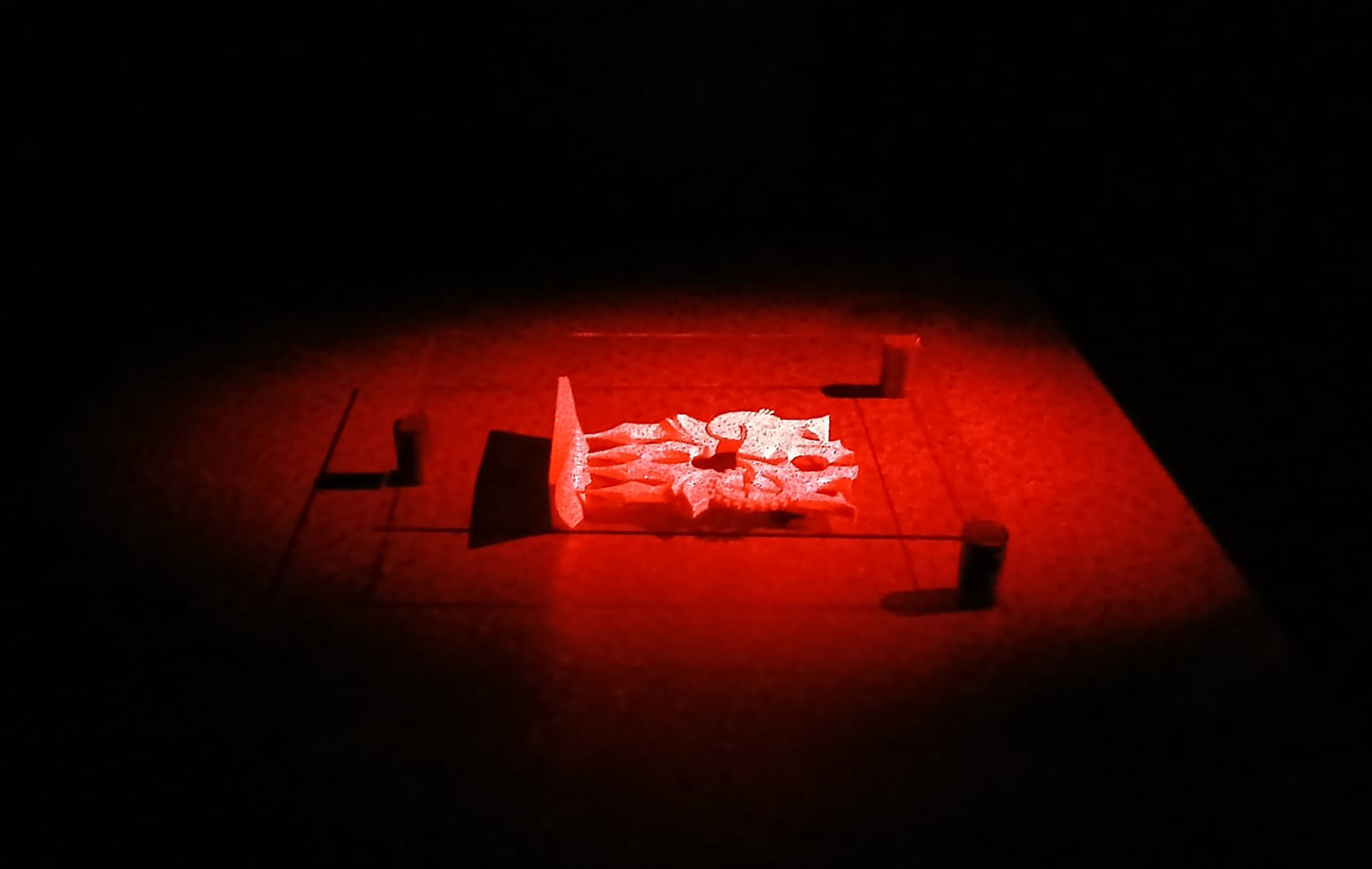
Silver halide Denisyuk holography
My silver halide holographic process includes:
TOVE (2026)
Cutting glass plates in very low light.
Dipping the plates in TEA (triethanolamine) to activate the substrate, in very low light.
Warming up the lasers.
Setting up the model so that it does not move by even a micron during the exposure.
Allowing the model to settle.
Exposing the hologram in silence, without any movement, in darkness (20–30 seconds).
Mixing the required developer and bleaching chemicals.
Developing and bleaching the hologram in very low light.
Carefully using a squeegee to remove any residue, then drying the hologram.
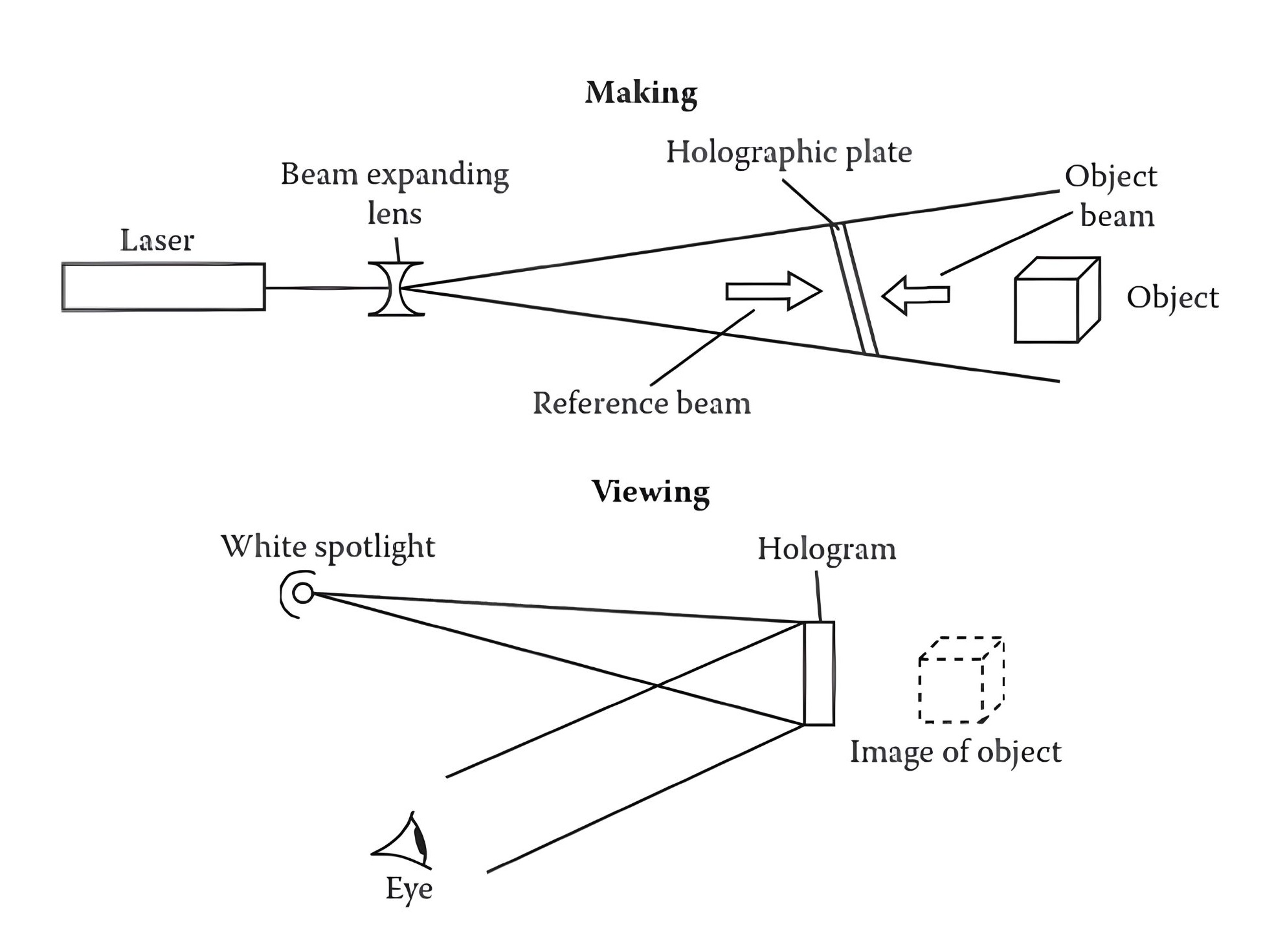
Below, you can see a diagram of the Denisyuk white light reflection holographic recording set-up.
DMU Holography PhD researcher Oliver Peacock has been an active member of the team developing and refining the optical set-ups required for Denisyuk holography.
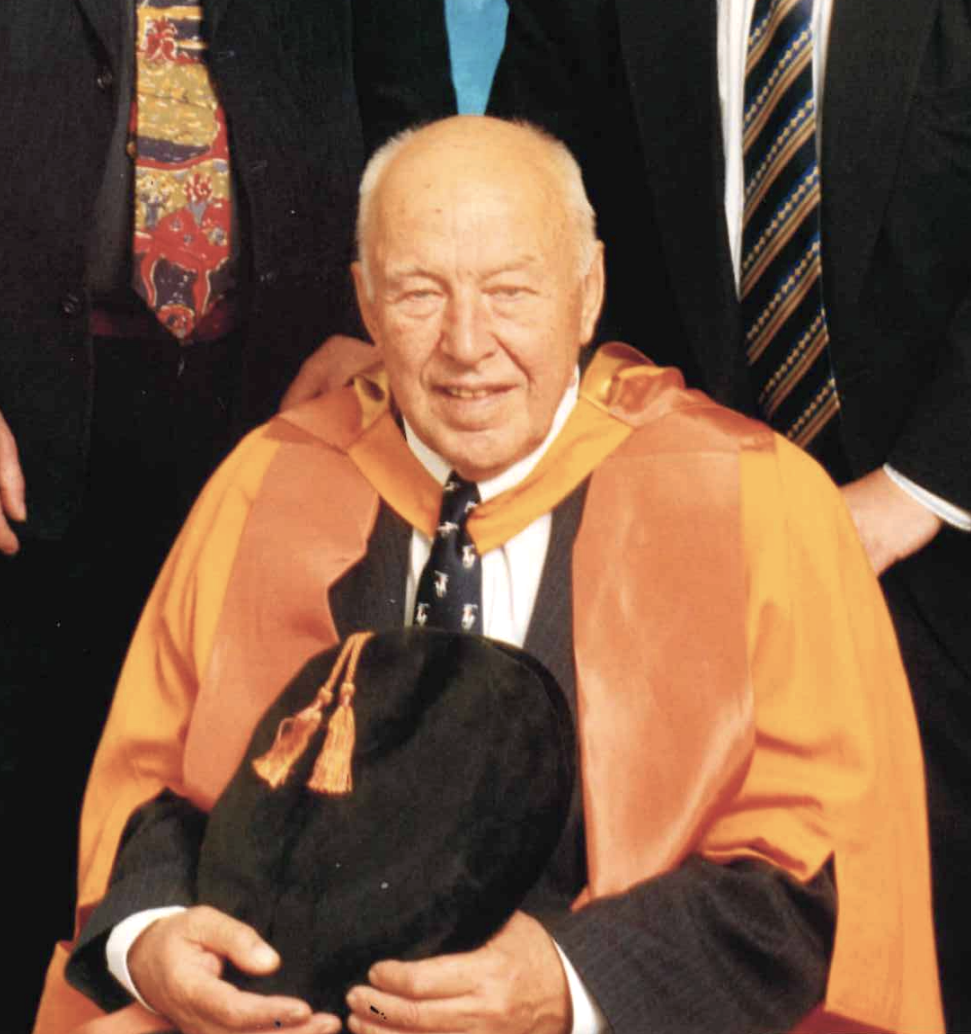
In 1999, Professor Yuri Denisyuk received an honorary Doctor of Science degree from De Montfort University.
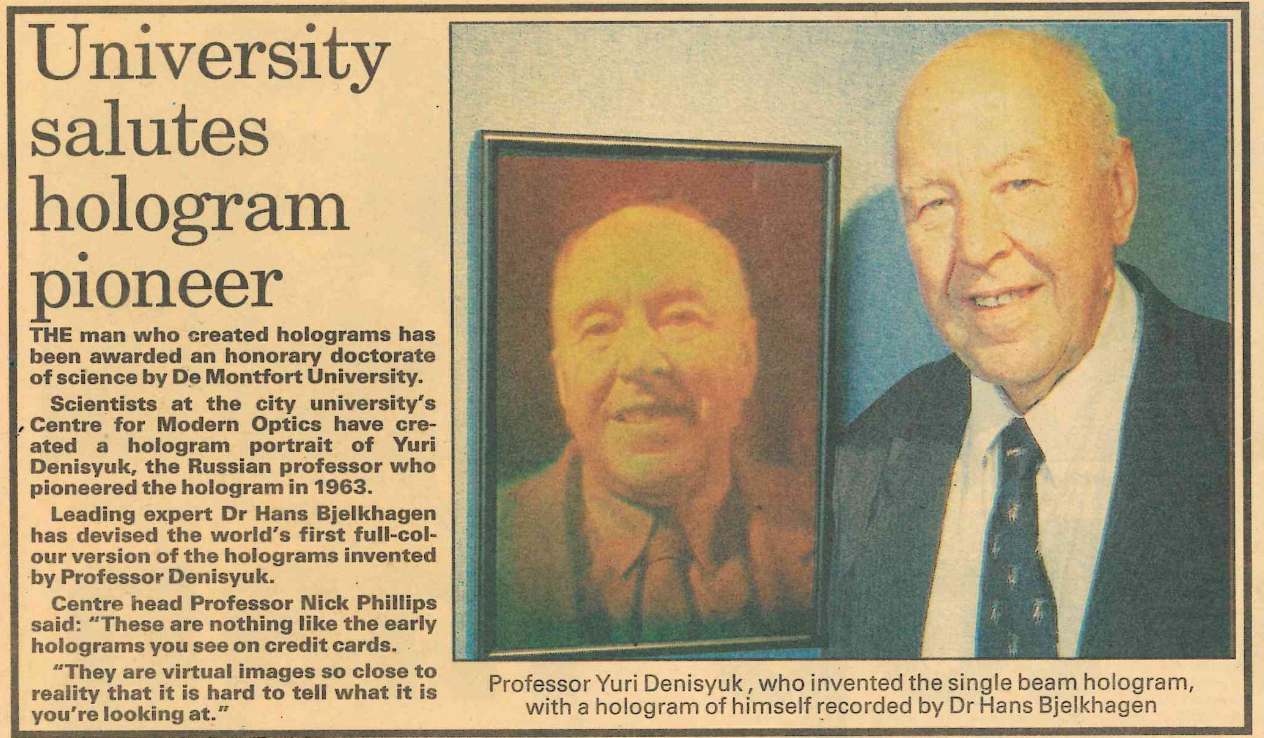
This Leicester Mercury article gets some of the details slightly wrong. Holography was invented by Dennis Gabor, who received the Nobel Prize in Physics in 1971 for “his invention and development of the holographic method”.
However, Denisyuk developed a specific type of hologram that can be viewed using, for example, a white spotlight in a gallery, rather than requiring a laser both to record and to view the hologram.
Holography
For a fundamental description of how holography works, I recommend Grant Sanderson’s How are holograms possible?
https://www.3blue1brown.com/lessons/holograms/
Holography is also featured in the 2026 Stories segment of the Nobel Prize website. Here, my PhD first supervisor and DMU Professor Emeritus Dr Martin Richardson is mentioned:
Holograms: The most perfect imaging medium ever made?
AI reflection
On 6 June 2026, Anthropic, the company that created the LLM Claude, called for a global pause in AI development.
Clark and Favaro (2026)
“We believe it would be good for the world to have the option to slow or temporarily pause frontier AI development to enable societal structures and alignment research to keep up with the advance of the technology.”
Pedagogies of Reflexivity
- Foster self-awareness, critical thinking, and an understanding of power dynamics.
- Encourage the challenging of assumptions, leading to personal and intellectual growth.
- Deepen engagement and social responsibility within the arts.
- Require vulnerability from educators, including uncertainty, empathy, and honesty.
- Highlight that teaching and research shape, and are shaped by, institutional contexts.
(Kan & Khoo, 2025; Hoveid & Hoveid, 2019)
Kan and Khoo (2025) argue that pedagogies of reflexivity offer a transformative approach to teaching and learning by inducing introspection and self-awareness, promoting critical thinking, and developing an understanding of power dynamics (McDowall, 2020).
By encouraging students [and ourselves] to reflect on their own perspectives, challenge assumptions, and make important intellectual and personally transformative moves (Benmayor, 2008), these pedagogies foster deeper engagement with the arts and heighten a sense of social responsibility.
As the reflexive process requires courage, humility, adaptability, empathy, thoughtfulness, and honesty, it is important to further explore the ‘vulnerability’ experienced by educators when they “switch from rational dialogue to the tensions associated with … a pedagogy of the unknowable” (Hibbert & Cunliffe, 2015).
Practice of reflexivity
What is the state of research in the universities, in AI, in the world, in Europe, in the United Kingdom of Great Britain and Northern Ireland, in England, in Leicester, and within myself and ourselves?
What is the situation within the universities, among colleagues and students?
How do we use AI ethically?
Are we inadvertently contributing to the development of, for example, Lethal Autonomous Weapons Systems through our use of, and training of, AI?
Can we build sustainable universities, building a circular economy, while fully implementing the use of AI?
How is this very current situation reflected in creative work so far?
…
I feel like I am always rushing. I feel like I barely scratch the surface of how to approach these questions.
Yet, in the holography lab, I have to be calm and methodical. The process invites a kind of mindfulness and meditation.
Tove (2026)
Giving the hologram a title
To develop a title, I gave the LLM Claude a brief background of the idea and context of the work. I also uploaded an image of the original cover.
Claude came up with several suggestions.
I suggested that the term transdisciplinary could be included.
Claude responded:
“Pairing it with the forward-facing idea from before:
Transdisciplinary Light, Carried Forward
Art, Technology, and the Light Between Them.“
I then requested that Claude make the suggestions a little more poetic. These were some of the many ideas it generated:
“Here’s a more poetic pass, leaning into the imagery already in the piece — light, gears, brushwork …
The Grammar of Light Between Disciplines
What the Gear Taught the Brush
Between Pigment and Mechanism, Light“
Claude’s chosen title was What the Gear Taught the Brush.
I then challenged Claude’s potential bias:
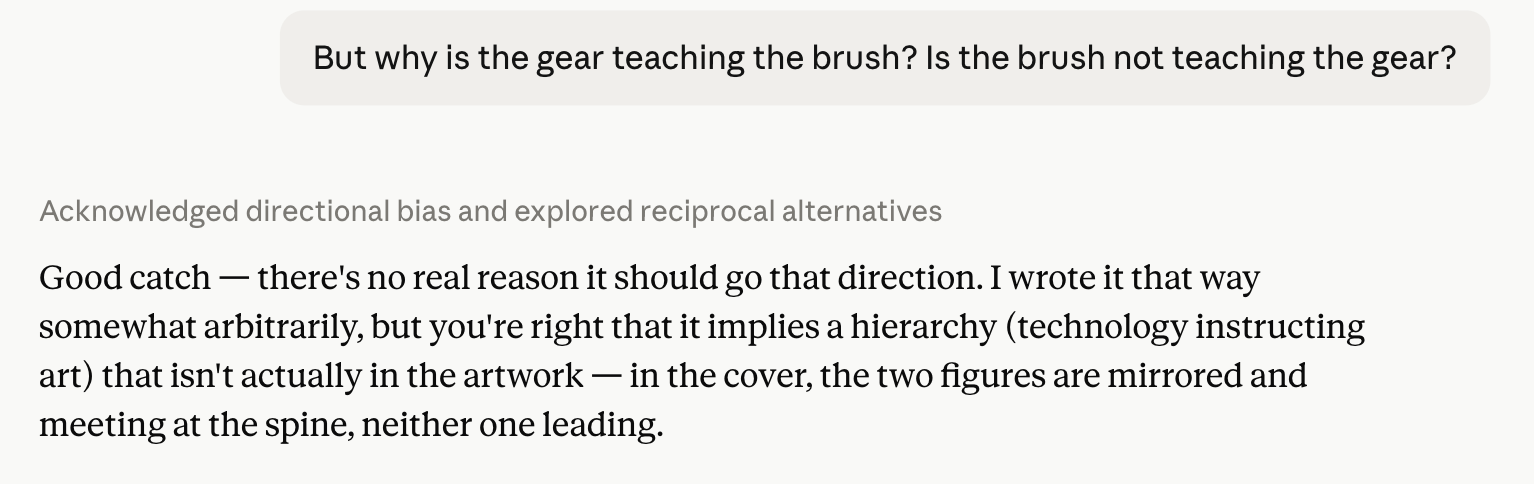
Based on my reading for the De Montfort University Symposium on Creative Knowing, I suggested to Claude that the term reflexive might be interesting, as Claude had already suggested using the term refracted.
In the end, following this conversation with Claude, I settled on my own variation: Reflexive Figures.
Claude responded:
“Reflexive Figures describes the artwork honestly (the mirrored figures, the medium reflecting/refracting light) without pointing the viewer toward a reading of the relationship in one direction or the other. Someone who wants to see resilience, mutual respect between disciplines, or even tension can all find it there, because ‘reflexive’ holds space for self-reference, reflection, and reaction all at once.”
Exhibition
It is notoriously difficult to photograph holograms; they demand the audience’s attention in person. A two-dimensional medium such as photography cannot capture the three-dimensional experience of a hologram. It is often even more difficult to photograph holograms in exhibition spaces, where reflections that do not disturb human perception in person can interfere with the documentation.
The day of the exhibition opening was unusually hot, making the potential changes to come due to global warming feel palpable.
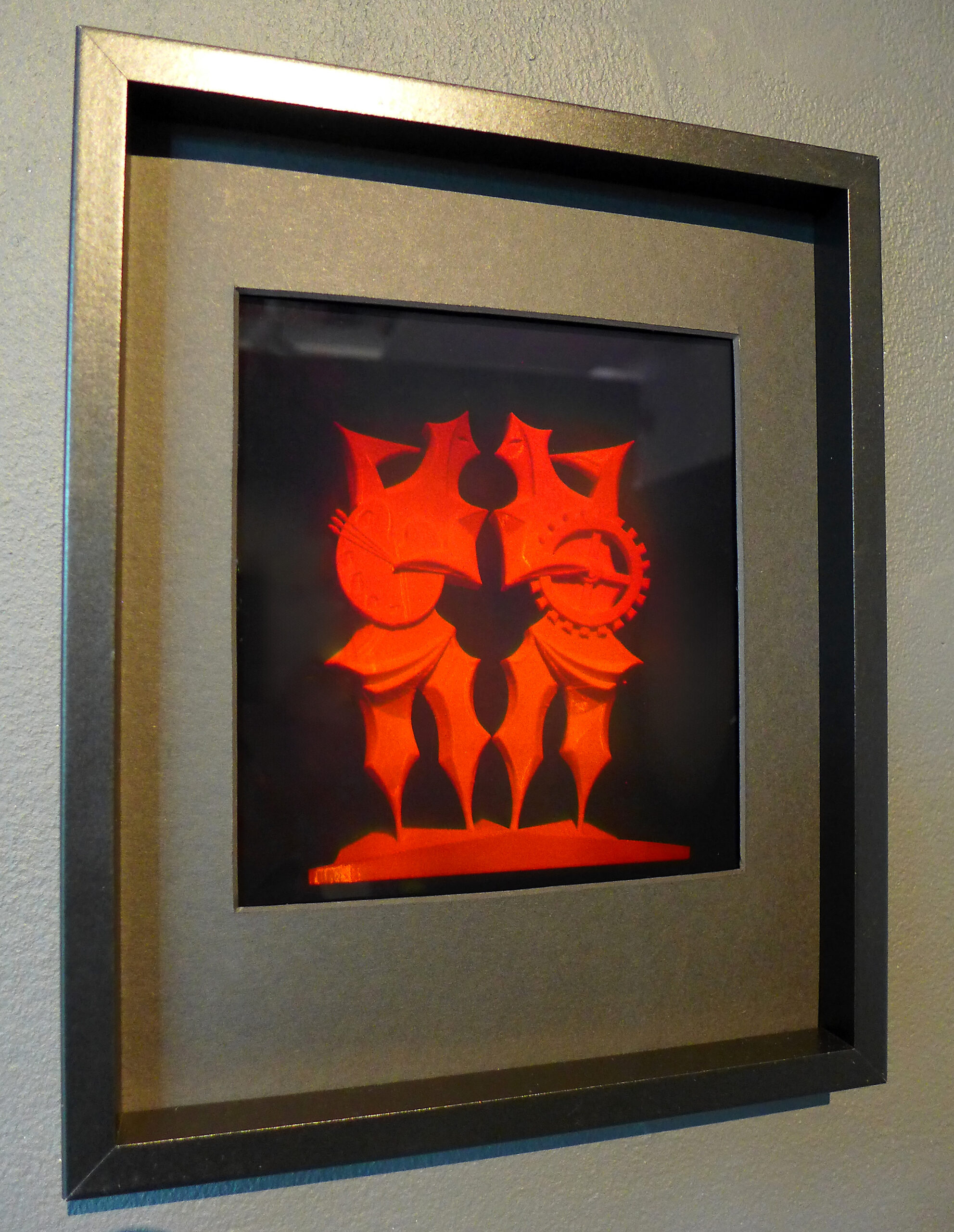
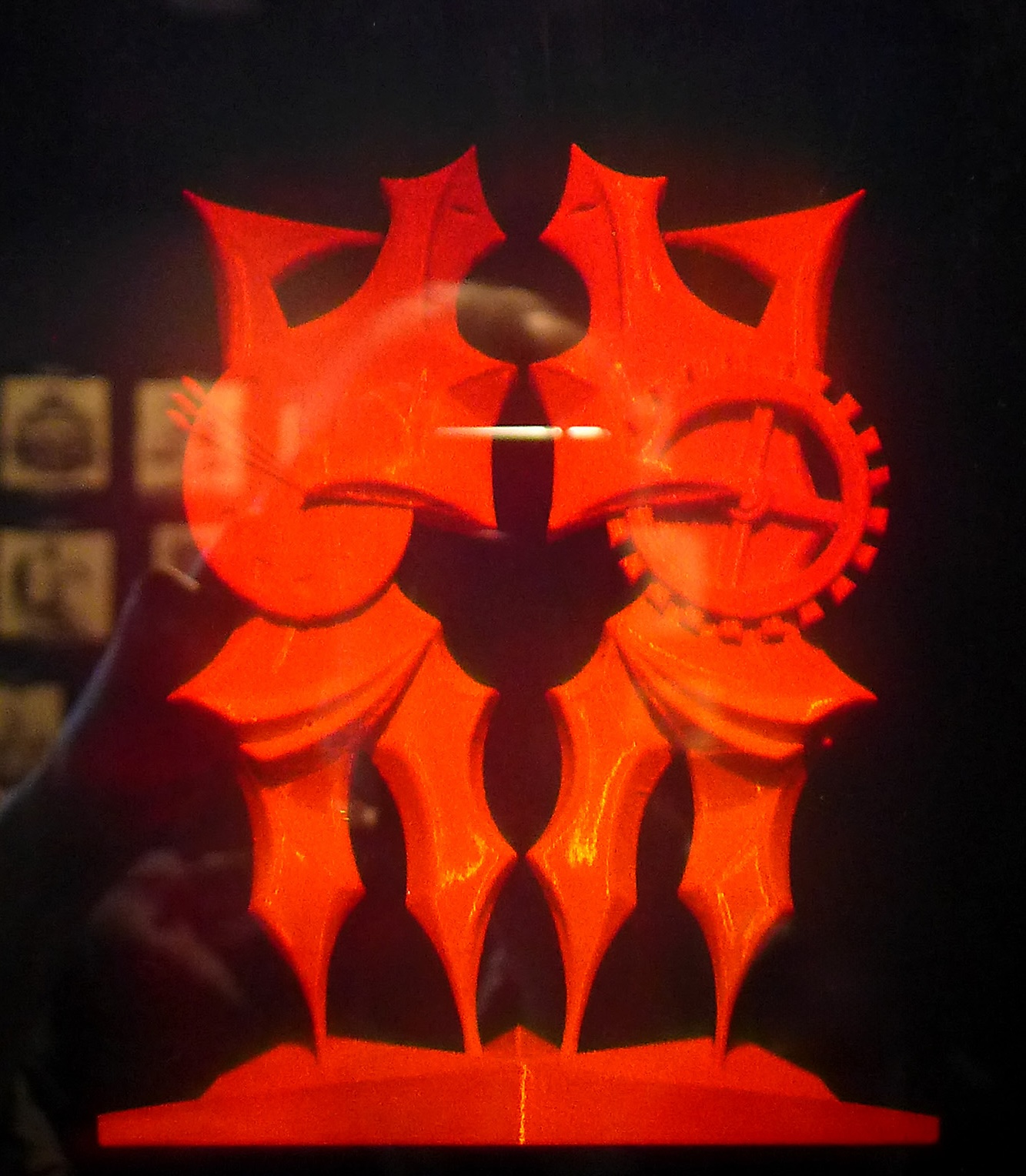
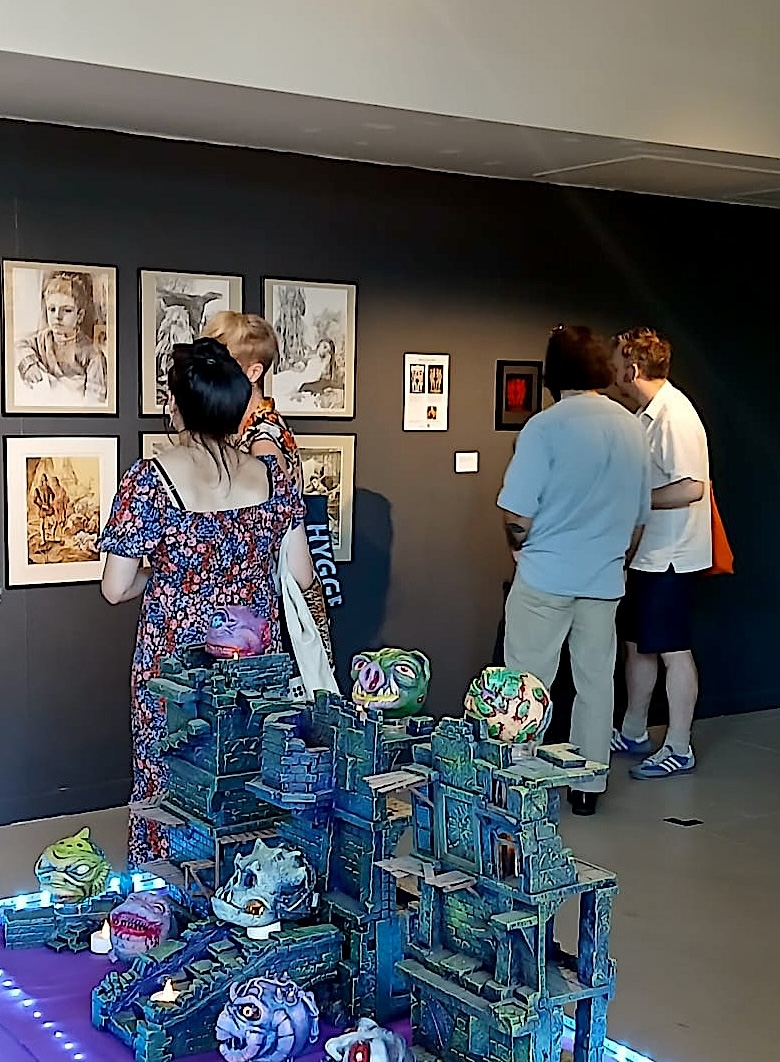
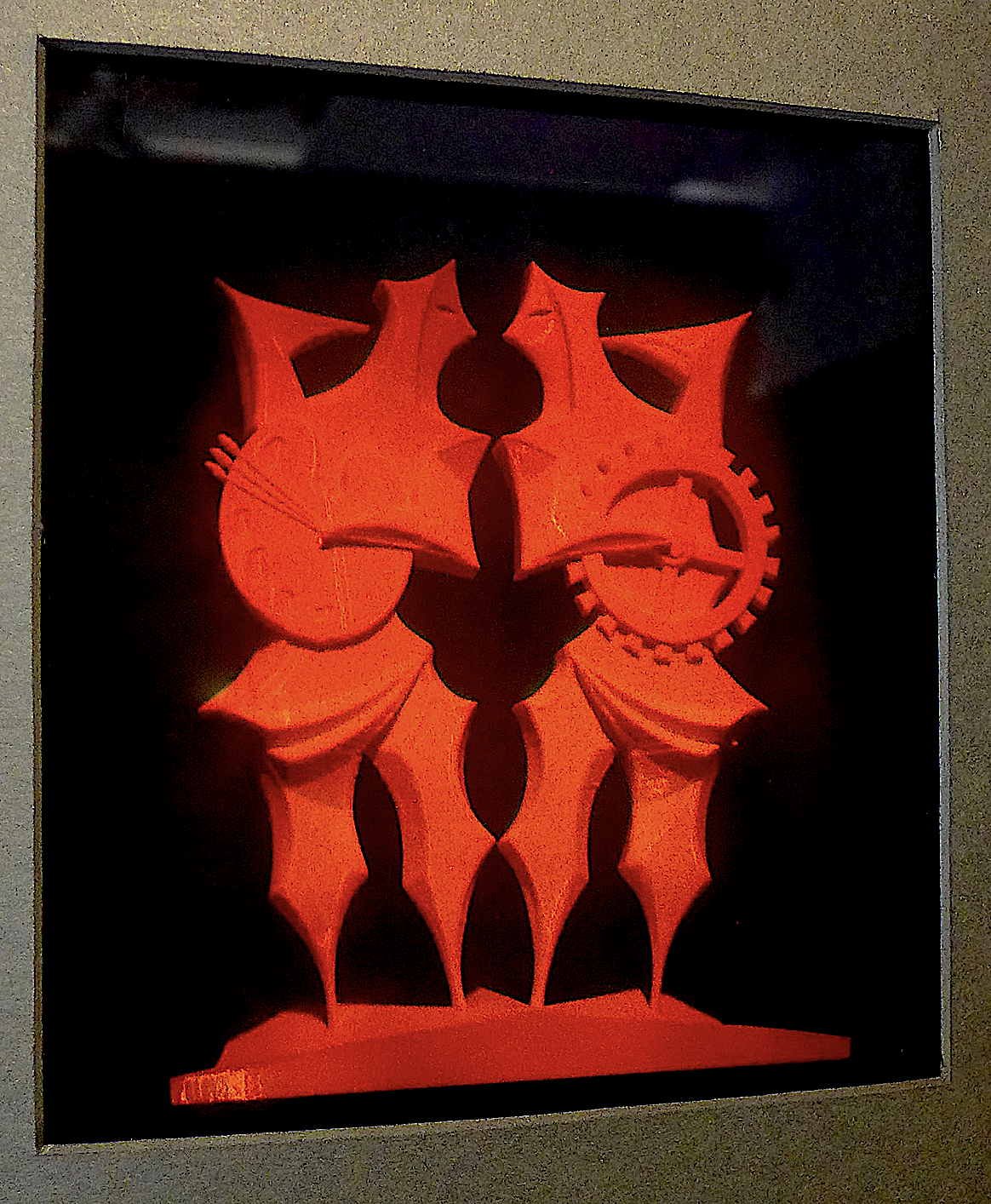
Reflexive Figures (2026), exhibited at the School of Creative Industries and Culture (CIC) Creative Practice Biennial, Leicester Gallery.
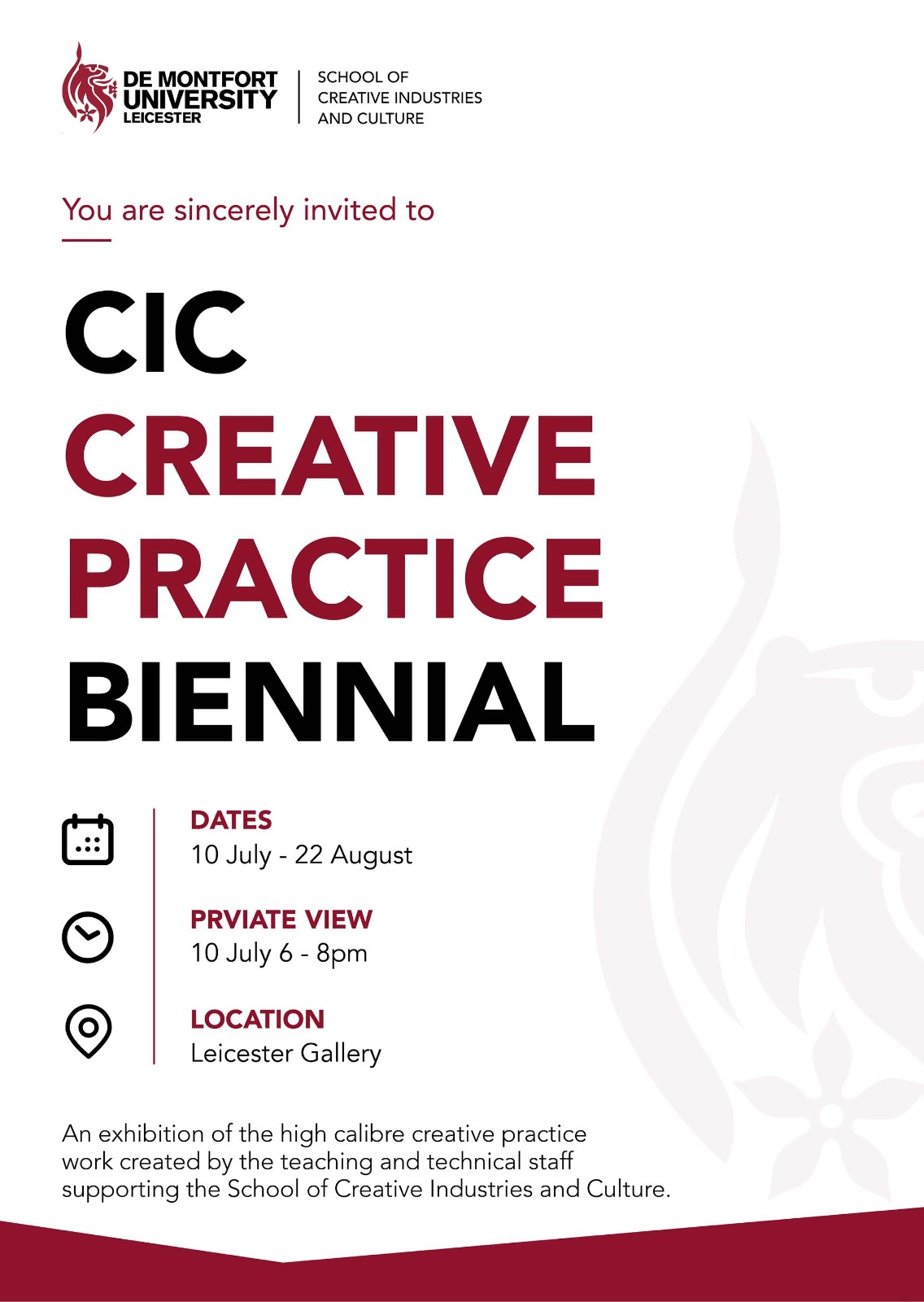
See current invitation below.
References:
Baraniuk, C. (2026) Holograms: The most perfect imaging medium ever made?, NobelPrize.org. Nobel Prize Outreach. Available at: https://www.nobelprize.org/stories/holograms/ (Accessed: July 12, 2026).
Bjelkhagen, H. (2009) “Denisyuk color holography for Display, Documentation and Measurement,” Journal of Holography and Speckle, 5(1), pp. 33–41. Available at: https://doi.org/10.1166/jhs.2009.006.
Calle , C. (2021) Superstrings and other things: A guide to physics. Taylor & Francis.
Dalenius, T.N. (2023) ‘Full-parallax digital holography, anatomy, and art’, Proc. SPIE 12445, Practical Holography XXXVII: Displays, Materials, and Applications, pp. 1–11. Available at: https://doi.org/10.1117/12.2650105.
Dalenius, T.N. (2024) ‘Revealing Emergence’, Scene, 12(1), pp. 43–63. Available at: https://doi.org/10.1386/scene_00070_1.
De Montfort University (2025) LibGuides: Using Generative Artificial Intelligence: What is generative AI?, Dmu.ac.uk. Available at: https://library.dmu.ac.uk/genai/what (Accessed: 7 June 2026).
Hoveid, H. and Hoveid, M.H. (2019) ‘Teaching – A Reflexive Approach’, Contemporary philosophies and theories in education, pp. 47–78. Available at: https://doi.org/10.1007/978-3-030-27076-6_3.
Kan, R.Y.P. and Khoo, C.S.G. (2025) ‘Codetta: Pedagogies of Reflexivity’, in Signature Pedagogies for Professions in Arts and Design. Springer , pp. 75–80.
Sanderson, G. (2024) 3Blue1Brown – How are holograms possible? | Optics puzzles 5, 3blue1brown.com. Available at: https://www.3blue1brown.com/lessons/holograms (Accessed: 24 April 2025).
Smith, S. (2022) ‘A play space for Practice-Based Phd Research’, in Routledge International Handbook of Practice-Based Research. Milton: Taylor & Francis Group, pp. 475–490.
United Nations Regional Information Centre for Western Europe (2025) UN addresses AI and the Dangers of Lethal Autonomous Weapons Systems. United Nations Regional Information Centre for Western Europe. Available at: https://unric.org/en/un-addresses-ai-and-the-dangers-of-lethal-autonomous-weapons-systems/ (Accessed: 25 June 2026)